
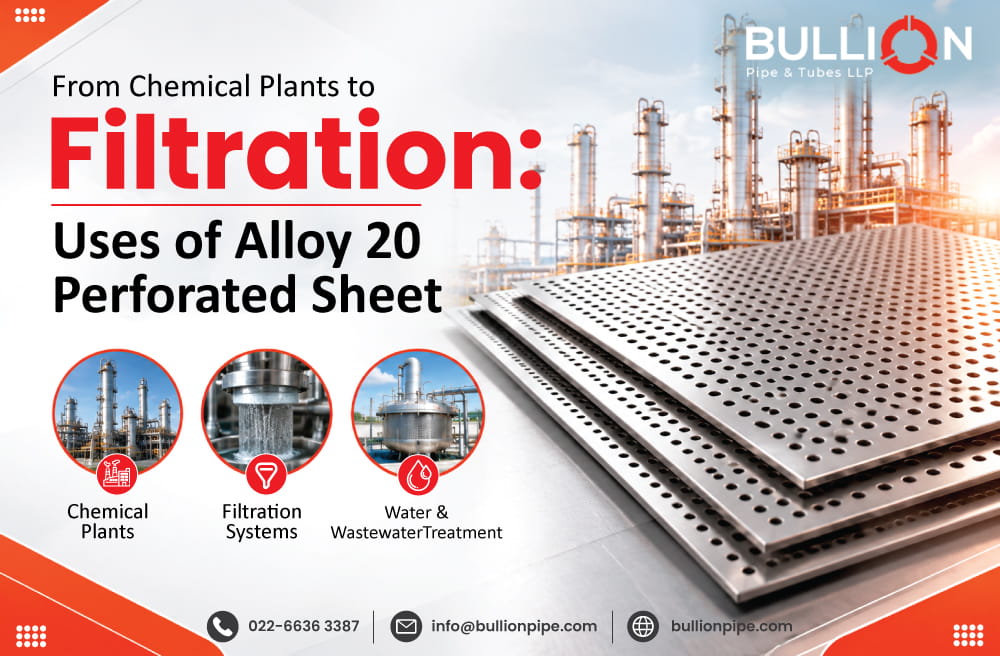
In industries where corrosion, chemical exposure, and operational reliability are constant concerns, choosing the right material is essential. From chemical processing plants to filtration systems, industrial buyers need materials that can withstand demanding environments without compromising performance. This is where Alloy 20 perforated sheet becomes a valuable option.
Alloy 20, also known as Carpenter 20, is a nickel-iron-chromium-based alloy containing copper and molybdenum. It is particularly recognised for its resistance to sulphuric acid and several other corrosive chemical environments. When manufactured into a perforated sheet, this alloy combines corrosion resistance with controlled openings that support filtration, screening, separation, and ventilation applications.
At Bullion Pipe and Tubes LLP, understanding industrial material requirements involves looking beyond specifications. The real question is how a material performs in its intended application, whether it is used in a chemical plant, a filtration assembly, or specialised industrial equipment.
What Is an Alloy 20 Perforated Sheet?
An Alloy 20 perforated sheet is a flat metal sheet manufactured with regularly or custom-positioned holes. These openings allow liquids, gases, and selected particles to pass through while helping retain larger particles or providing a controlled flow path.
The base material, Alloy 20, offers a combination of corrosion resistance, mechanical strength, and fabrication versatility. Its chemical composition generally includes nickel, chromium, iron, copper, and molybdenum, with additional elements such as niobium used to improve resistance to certain forms of corrosion.
The performance of an Alloy 20 perforated sheet depends on factors such as sheet thickness, hole diameter, hole pattern, open-area percentage, operating temperature, and the chemical composition of the process fluid.
For industrial buyers, selecting the correct configuration is just as important as choosing the alloy itself.
Chemical Processing Plants: Supporting Corrosion-Resistant Operations
Chemical processing is one of the most important application areas for Alloy 20. Equipment in these facilities may encounter acidic solutions, aggressive process fluids, and environments that accelerate the deterioration of conventional metals.
Alloy 20 is particularly valued for its resistance to sulphuric acid under suitable service conditions. A perforated sheet made from this alloy can be incorporated into selected process equipment where fluid passage, separation, or protective screening is required.
Typical applications may include:
- Internal screening components in chemical processing equipment.
- Protective screens for selected process systems.
- Perforated elements used in liquid distribution assemblies.
- Specialised baskets and support structures exposed to corrosive fluids.
However, the alloy should not be considered universally resistant to every chemical. Concentration, temperature, impurities, aeration, and exposure duration can significantly affect corrosion performance. Industrial engineers should verify compatibility with the actual process conditions before selecting the material.
Filtration Systems: Enabling Controlled Separation
Filtration is another application where Alloy 20 perforated sheet can prove useful. Industrial filtration systems often require a supporting structure that allows fluid movement while maintaining dimensional stability and resisting corrosion.
The perforations provide defined openings through which liquids or gases can pass. Depending on the design, the sheet may serve as a support layer for filter media, a protective screen, or a coarse separation component.
Potential applications include:
- Support plates for compatible filter assemblies.
- Industrial liquid filtration equipment.
- Strainers and screening components.
- Perforated supports in chemical separation systems.
One important distinction is that a perforated sheet is not necessarily a fine filtration medium. Its openings are generally larger than those of woven wire mesh or specialised filter membranes. Consequently, the hole size must match the required particle-retention level.
For applications involving corrosive liquids, engineers should evaluate both the chemical compatibility of the alloy and the filtration efficiency of the selected perforation pattern.
Pharmaceutical and Speciality Chemical Manufacturing
Pharmaceutical production and speciality chemical manufacturing often involve controlled processing environments where equipment cleanliness, chemical compatibility, and repeatable performance are important.
An Alloy 20 perforated sheet may be considered for selected equipment components where its corrosion resistance is appropriate for the process chemistry. Examples include screening assemblies, support structures, and specialised separation equipment.
Nevertheless, the suitability of Alloy 20 depends on the specific cleaning agents, sanitisation procedures, product-contact requirements, and applicable industry standards. Where hygienic design is essential, surface finish, cleanability, material certification, and regulatory requirements must also be considered.
The objective is to select a material that meets the complete operating requirement rather than relying on corrosion resistance alone.
Industrial Screens, Strainers, and Protective Components
Perforated metal sheets are widely used to create screens, guards, strainers, and protective covers. When these components operate in chemically aggressive environments, material selection becomes especially important.
An Alloy 20 perforated sheet can be evaluated for selected applications such as:
- Protective covers for process equipment.
- Corrosion-resistant screening panels.
- Coarse strainers for compatible process fluids.
- Internal supports and separators in industrial assemblies.
The appropriate hole diameter, pitch, and sheet thickness will depend on the pressure difference across the sheet, the expected flow rate, the size of particles being retained, and the mechanical loads involved.
A properly designed component should balance open area with structural strength. Excessive open area can reduce the material available to support loads, while openings that are too small may restrict flow or become blocked.
Wastewater Treatment and Corrosive Liquid Handling
Industrial wastewater treatment facilities may handle acidic wastewater, chemical residues, and process streams containing dissolved or suspended substances. Some equipment therefore requires materials that can tolerate challenging chemical conditions.
An Alloy 20 perforated sheet may be suitable for selected screening, separation, or support applications when the wastewater chemistry falls within the alloy’s verified resistance range.
Before installation, buyers should consider the presence of chlorides, oxidising compounds, suspended solids, and other contaminants that could influence corrosion. These factors can make a significant difference to material performance.
A technical review of the operating environment helps prevent premature deterioration and supports more reliable equipment selection.
How to Choose the Right Alloy 20 Perforated Sheet
When sourcing an Alloy 20 perforated sheet, industrial buyers should assess several factors before placing an order.
Material grade and certification: Confirm the Alloy 20 designation, applicable material standard, and traceability documentation required for the project.
Thickness and dimensions: Select the sheet thickness, width, and length according to structural requirements and fabrication needs.
Hole diameter and pattern: Choose round, square, slotted, or other available perforation patterns based on the required flow and separation characteristics.
Open-area percentage: A higher open area may improve flow but can reduce stiffness and load-bearing capacity.
Operating conditions: Verify compatibility with the actual chemicals, concentration, temperature, pressure, and cleaning procedures.
Fabrication requirements: Consider cutting, forming, welding, finishing, and dimensional tolerances when specifying the final component.
Bullion Pipe and Tubes LLP can use these considerations as a starting point when evaluating material requirements for industrial buyers. The final selection should be based on the project’s technical specifications and verified material availability.
From chemical plants to filtration equipment, Alloy 20 perforated sheet offers a combination of corrosion resistance and functional versatility for applications where controlled openings are essential. Its potential uses include chemical processing components, filter supports, industrial screens, strainers, and selected wastewater treatment equipment.
However, successful performance depends on more than the alloy designation. Hole configuration, thickness, fabrication quality, and the actual operating environment all influence the final result.
For industrial buyers, the most effective approach is to identify the application first, establish the required performance parameters, and then verify material suitability.
Bullion Pipe and Tubes LLP can be approached for enquiries concerning Alloy 20 material requirements, subject to product availability and the specifications of the intended application. So, Get in Contact with us now to buy Alloy 20 Perforated Sheet in India of Premium quality at an affordable Alloy 20 Perforated Sheet Price in India.
1. What is an Alloy 20 perforated sheet used for?
An Alloy 20 perforated sheet is used in selected chemical processing equipment, filtration supports, industrial screens, strainers, and separation assemblies where corrosion resistance and controlled openings are required.
2. Why is Alloy 20 suitable for chemical processing applications?
Alloy 20 offers good resistance to sulphuric acid in many service conditions. Its suitability depends on acid concentration, temperature, contaminants, and other operating parameters.
3. Can Alloy 20 perforated sheet be used for filtration?
Yes. It can serve as a coarse screening element, filter-media support, or component of a filtration assembly. The hole size and open area must match the required flow rate and particle-retention level.
4. How do buyers select the correct Alloy 20 perforated sheet?
Buyers should consider material certification, sheet thickness, hole diameter, perforation pattern, open-area percentage, chemical exposure, temperature, and mechanical loading requirements.
5. Where can buyers enquire about Alloy 20 perforated sheet in India?
Industrial buyers can contact Bullion Pipe to enquire about Alloy 20 material requirements, product specifications, and availability. Grade certification, dimensions, perforation options, and delivery terms should be confirmed before ordering.