
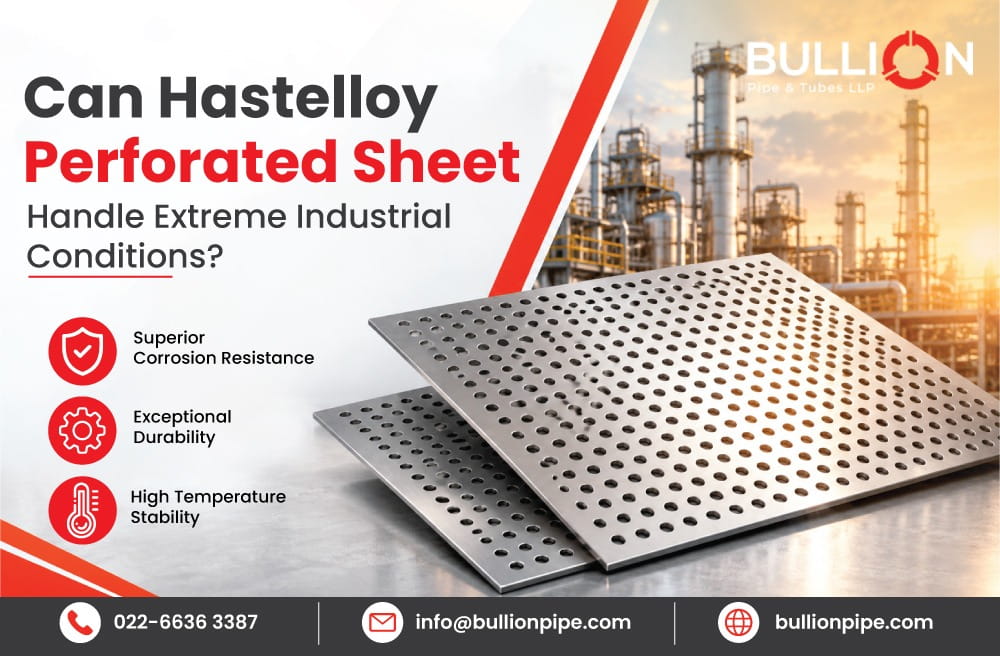
In industries where high temperatures, aggressive chemicals, and corrosive environments challenge the reliability of conventional metals, material selection becomes a critical business decision. A component that performs well under ordinary conditions may deteriorate rapidly when exposed to acids, chemical fumes, or demanding process environments. This is where a Hastelloy perforated sheet can offer a valuable solution for specialised industrial applications.
At Bullion Pipe and Tubes LLP, we recognise that industrial buyers need materials that deliver more than structural strength. They need dependable corrosion resistance, application-specific performance, and long-term operational reliability. Hastelloy alloys are known for their resistance to many aggressive chemical environments, making perforated sheets manufactured from suitable Hastelloy grades an important option for demanding industrial requirements.
But can a Hastelloy perforated sheet really handle extreme industrial conditions? The answer depends on the alloy grade, operating temperature, chemical concentration, perforation design, and the conditions in which the sheet will be used.
What Is a Hastelloy Perforated Sheet?
A Hastelloy perforated sheet is a metal sheet manufactured from a suitable nickel-based corrosion-resistant alloy and processed with regularly arranged holes. These perforations allow controlled passage of liquids, gases, and fine particles while retaining a degree of structural support.
Unlike ordinary perforated stainless steel sheets, Hastelloy perforated sheets can provide enhanced resistance to specific aggressive chemicals, depending on the grade selected.
Common applications include chemical processing equipment, filtration systems, industrial screens, separation units, gas handling systems, and specialised process equipment.
The combination of corrosion resistance and an open-hole design makes this material useful where industries require both chemical durability and controlled flow.
Why Is Hastelloy Perforated Sheet Suitable for Extreme Industrial Conditions?
Resistance to Aggressive Chemicals
Chemical exposure is one of the biggest challenges in industrial manufacturing. Acids, chlorides, and other corrosive substances can damage unsuitable metals, leading to maintenance expenses, equipment downtime, and premature component failure.
Certain Hastelloy grades are specifically engineered to withstand demanding chemical environments. For example, Hastelloy C-276 is widely recognised for its resistance to a broad range of corrosive media, while Hastelloy C-22 offers strong resistance to various oxidising and reducing environments.
For industrial buyers searching for a Hastelloy perforated sheet, the correct grade must be selected according to the chemicals involved, their concentration, temperature, and exposure duration.
At Bullion Pipe and Tubes LLP, understanding the operating environment is an essential starting point when evaluating materials for demanding applications.
Performance at Elevated Temperatures
Extreme industrial conditions often involve elevated temperatures alongside chemical exposure. A suitable nickel-based alloy may retain useful mechanical properties and corrosion resistance in environments where conventional materials become less reliable.
However, Hastelloy perforated sheet is not universally suitable for every high-temperature application. Its maximum operating temperature depends on the specific grade, mechanical loading, atmosphere, and exposure conditions.
Perforations also influence the sheet’s strength because the openings reduce the amount of load-bearing material. Therefore, engineers should assess the sheet’s thickness, hole diameter, pitch, and support arrangement before approving it for high-temperature service.
Reliable Performance in Filtration and Separation
Filtration is another important application for Hastelloy perforated sheets. Chemical plants, process industries, and specialised manufacturing facilities may need screens that allow fluid movement while retaining particles or supporting filtration media.
A properly designed Hastelloy perforated sheet can help maintain the required flow pattern while resisting corrosion from compatible process fluids.
The hole size, sheet thickness, open area, and hole arrangement determine how the sheet performs. For instance, smaller holes may support finer separation requirements, while larger openings can provide greater flow capacity.
The final design must balance filtration requirements with mechanical strength and the possibility of clogging.
Durability in Demanding Industrial Environments
Corrosion can gradually weaken industrial components, particularly when chemical attack occurs around edges, joints, and exposed surfaces. Selecting a suitable Hastelloy grade can help reduce corrosion-related deterioration in compatible environments.
Nevertheless, the term extreme industrial conditions covers many different situations. High chloride concentrations, stagnant liquids, mixed chemicals, erosion, and unexpected temperature changes may affect performance differently.
A Hastelloy perforated sheet should therefore be assessed against the actual service conditions rather than selected solely because the material belongs to a corrosion-resistant alloy family.
Which Hastelloy Grade Should Industrial Buyers Consider?
Choosing the right alloy is just as important as selecting the correct perforation pattern.
- Hastelloy C-276: Often considered for chemical processing applications involving a broad range of corrosive environments, including certain acids and chloride-containing media.
- Hastelloy C-22: Commonly considered for applications involving strong resistance to several oxidising and reducing corrosive environments.
- Other Hastelloy grades: May be appropriate for specialised chemical, thermal, or process requirements depending on their specific properties.
These grades are not interchangeable in every application. The selection should be based on technical datasheets, chemical compatibility information, relevant material standards, and engineering assessment.
For buyers sourcing a Hastelloy perforated sheet in India, confirming the exact grade, material certification, dimensions, and manufacturing requirements helps minimise specification-related problems.
What Factors Affect Hastelloy Perforated Sheet Performance?
Before placing an order, industrial buyers should evaluate five important considerations.
Material grade: Confirm whether the selected alloy is suitable for the process chemicals and temperature.
Sheet thickness: Ensure the sheet can withstand the expected mechanical loads and operating pressure.
Hole diameter and pitch: Select a perforation pattern that meets the required flow, filtration, and strength requirements.
Manufacturing quality: Check dimensional accuracy, edge condition, surface finish, and the quality of the perforations.
Operating environment: Consider chemical concentration, pressure, temperature fluctuations, flow velocity, and potential erosion.
These checks are particularly important when the sheet will be installed in chemical filtration units, separation equipment, or components exposed to continuous corrosive service.
Where Is Hastelloy Perforated Sheet Used?
Hastelloy perforated sheets can be considered for several specialised applications, including:
- Chemical processing and acid-handling equipment.
- Industrial filtration and separation systems.
- Corrosion-resistant screens and process supports.
- Gas treatment and selected pollution-control equipment.
- Specialised equipment used in pharmaceutical and fine chemical manufacturing.
Actual suitability depends on the selected alloy and the application’s technical requirements. For example, a sheet suitable for one acid-handling process may not be suitable for a different chemical mixture at a higher temperature.
Why Choose Bullion Pipe and Tubes LLP for Hastelloy Perforated Sheet Requirements?
For industrial procurement teams, selecting a material involves more than comparing prices. Buyers must ensure that the specified alloy, dimensions, and perforation pattern meet the equipment’s operating requirements.
Bullion Pipe and Tubes LLP understands the importance of evaluating material specifications before procurement. Industrial buyers should confirm grade availability, sheet dimensions, thickness, perforation details, applicable standards, and material test certificates before finalising an order.
When requesting a quotation, buyers can provide the intended application, required alloy grade, sheet thickness, hole diameter, pitch, quantity, and operating conditions. These details help suppliers assess the requirement more accurately.
A well-specified Hastelloy perforated sheet can contribute to reliable process performance, reduced corrosion-related maintenance, and better equipment service life when the selected material is compatible with its operating environment.
Yes, a suitably selected Hastelloy perforated sheet can handle many demanding industrial conditions involving aggressive chemicals, corrosive fluids, and certain elevated-temperature applications. Its performance, however, depends on choosing the appropriate alloy and designing the perforations to meet the required mechanical and process conditions.
For industries where material failure can lead to downtime, maintenance costs, or process interruptions, careful material selection is essential.
Bullion Pipe and Tubes LLP encourages industrial buyers to evaluate chemical compatibility, operating temperature, sheet thickness, perforation geometry, and material certification before making a purchasing decision. With the right specifications and engineering assessment, Hastelloy perforated sheets can become a valuable component in demanding industrial systems.
So, to buy Hastelloy Perforated Sheet in India of Premium Quality at an affordable Hastelloy Perforated Sheet Price in India please ‘Get in Touch’ with us now.
1. What is a Hastelloy perforated sheet used for?
A Hastelloy perforated sheet is used in specialised filtration systems, chemical processing equipment, industrial screens, separation units, and other applications requiring controlled fluid passage and corrosion resistance.
2. Can Hastelloy perforated sheet withstand high temperatures?
Certain Hastelloy grades can retain useful mechanical properties and corrosion resistance at elevated temperatures. The maximum suitable operating temperature depends on the grade, atmosphere, mechanical load, and service conditions.
3. Which Hastelloy grade is best for perforated sheets in chemical industries?
Hastelloy C-276 and Hastelloy C-22 are commonly considered for demanding chemical environments. The best grade depends on the specific chemicals, concentrations, temperatures, and operating conditions.
4. What factors affect the price of Hastelloy perforated sheet in India?
The price depends on the alloy grade, sheet thickness, dimensions, hole diameter, perforation pattern, open area, order quantity, raw material costs, and manufacturing requirements. Buyers should request quotations based on complete specifications.
5. How can buyers select a reliable Hastelloy perforated sheet supplier?
Buyers should verify the supplier’s ability to meet the required alloy grade, dimensions, perforation specifications, quality requirements, and documentation needs. Material test certificates and technical compatibility checks are particularly important for critical industrial applications.