
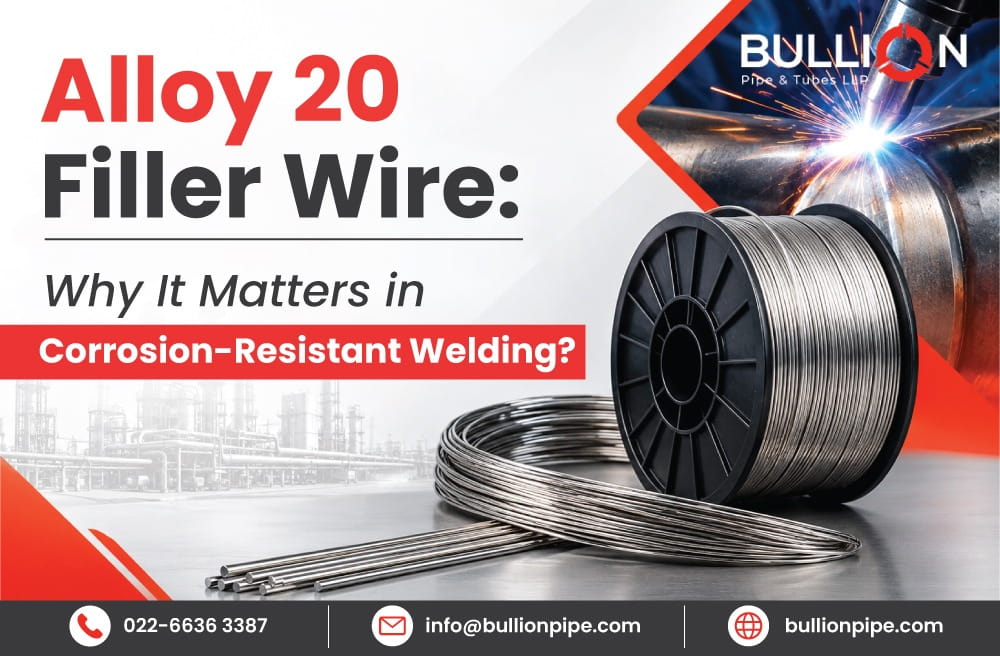
In industries where corrosion can damage equipment, interrupt production, and increase maintenance costs, selecting the right welding consumable is just as important as choosing the right base metal. Chemical processing plants, pharmaceutical facilities, food processing units, and industrial manufacturing operations often work with aggressive chemicals that demand reliable corrosion resistance. This is where Alloy 20 filler wire becomes an important consideration for corrosion-resistant welding applications.
At Bullion Pipe and Tubes LLP, we understand that industrial welding is not simply about joining two metal components. It is about maintaining the strength, integrity, and service life of equipment operating under challenging conditions. The right filler wire helps create a suitable weld joint while supporting the corrosion resistance required by the application.
But what makes Alloy 20 filler wire suitable for specialised welding, and how can industries determine whether it is the right choice?
What Is Alloy 20 Filler Wire?
Alloy 20 filler wire is a nickel-iron-chromium-based welding consumable associated with Alloy 20, a corrosion-resistant alloy commonly identified by UNS N08020. The alloy contains nickel, chromium, molybdenum, and copper, with niobium added to help stabilise the material against certain forms of intergranular corrosion.
Alloy 20 is particularly known for its resistance to sulphuric acid in many industrial environments. Its performance in other chemical media depends on factors such as concentration, temperature, impurities, and operating conditions.
The filler wire is used in suitable welding procedures to join compatible Alloy 20 components or make appropriate dissimilar-metal joints. Depending on the welding process and application requirements, the relevant consumable may be specified under classifications such as ER320LR. The exact classification must be confirmed against the applicable standard, material specifications, and welding procedure.
For buyers searching for alloy 20 filler wire suppliers in India, understanding the material grade and intended application is essential before placing an order.
Why Does Alloy 20 Filler Wire Matter in Corrosion-Resistant Welding?
1. Helps Maintain Corrosion Resistance at Welded Joints
A welded joint can become a vulnerable area if the filler metal is incompatible with the base material or the welding procedure is unsuitable. Even when the parent metal offers excellent corrosion resistance, poor consumable selection can compromise the performance of the completed fabrication.
Alloy 20 filler wire is selected to help achieve the metallurgical compatibility and corrosion performance required for appropriate Alloy 20 welding applications.
This matters in chemical processing equipment, where welded pipes, tanks, vessels, and associated components may encounter corrosive liquids throughout their service life.
2. Supports Performance in Sulphuric Acid Environments
One of the recognised advantages of Alloy 20 is its resistance to sulphuric acid under many service conditions. The combination of nickel, chromium, molybdenum, and copper contributes to its corrosion-resistant properties.
For manufacturers working with acid-handling equipment, the choice of filler metal must consider the actual chemical environment rather than relying on the alloy name alone.
The concentration of the acid, operating temperature, flow conditions, contaminants, and exposure duration can influence corrosion behaviour. Therefore, engineers should verify that the complete welded assembly is suitable for the intended process conditions.
3. Helps Reduce Premature Weld Failure
Weld failures can lead to leakage, unexpected shutdowns, product contamination, and expensive repairs. Selecting an appropriate filler wire is one part of preventing these problems.
When used with suitable joint preparation, controlled welding parameters, qualified procedures, and proper inspection, Alloy 20 filler wire can contribute to reliable welded joints in compatible applications.
However, the consumable alone cannot guarantee weld quality. Storage, cleanliness, welder qualification, heat input, and post-weld requirements must also be considered.
4. Supports Long-Term Industrial Reliability
For plant operators, the real value of corrosion-resistant welding lies in dependable equipment performance over time. A suitable welding consumable can help maintain the intended properties of the fabricated component, reducing the risk of corrosion-related maintenance when the complete design and welding procedure are appropriate.
This is particularly relevant in industries where equipment downtime affects production schedules, operational budgets, and delivery commitments.
Key Industrial Applications of Alloy 20 Filler Wire
Alloy 20 filler wire may be considered for compatible fabrication and repair work in several industries.
Chemical processing: Used in suitable equipment handling sulphuric acid and other corrosive process media.
Pharmaceutical manufacturing: Relevant to selected process vessels, piping systems, and fabricated equipment where material compatibility and cleanliness are important.
Specialty chemical plants: Considered for compatible tanks, transfer lines, and process components exposed to aggressive chemicals.
Food and allied processing: May be used in suitable specialised equipment when corrosion resistance and the required material specifications justify its selection.
Industrial fabrication: Used for compatible Alloy 20 assemblies and approved dissimilar-metal welding applications.
The final selection should always be based on the service environment, applicable codes, base-metal grade, and qualified welding procedure.
How to Choose the Right Alloy 20 Filler Wire
When evaluating Alloy 20 filler wire for an industrial project, procurement teams and welding engineers should consider the following factors.
1. Verify the consumable classification. Confirm whether the required specification is ER320LR or another appropriate classification. Do not assume that every Alloy 20-labelled wire is interchangeable.
2. Match the base material. Check the material test certificates and confirm compatibility with the component being welded.
3. Evaluate operating conditions. Review the chemical composition of the process medium, concentration, temperature, pressure, and potential contaminants.
4. Check dimensions and packaging. Select the wire diameter, spool format, and quantity suitable for the welding process and production requirements.
5. Review quality documentation. Request applicable certificates, traceability records, and compliance documents from the supplier.
6. Confirm technical support. Consult a qualified welding engineer when dealing with dissimilar metals, demanding service conditions, or critical pressure-containing equipment.
For companies looking for an Alloy 20 filler wire supplier in India, these checks can help improve purchasing decisions and reduce the risk of material mismatches.
Alloy 20 Filler Wire vs Standard Stainless Steel Filler Wire
Standard stainless steel filler wires may be suitable for many general-purpose fabrication applications, but they should not automatically replace a consumable specifically selected for Alloy 20.
The alloys differ in their chemical composition, corrosion behaviour, and intended service conditions. Alloy 20’s nickel, molybdenum, and copper content contributes to its performance in particular corrosive environments.
A standard stainless steel filler may not provide equivalent performance in a given chemical medium. Conversely, Alloy 20 filler wire is not necessarily the most economical or technically appropriate choice for every stainless steel application.
The decision should be based on compatibility, corrosion testing where necessary, engineering specifications, and the applicable welding procedure.
Why Choose Bullion Pipe and Tubes LLP for Industrial Material Requirements?
At Bullion Pipe and Tubes LLP, understanding material requirements begins with understanding the application. Industrial buyers need more than a product name; they need clarity regarding grade, specification, dimensions, documentation, and suitability for the intended service.
When sourcing Alloy 20 filler wire, buyers should communicate the required classification, wire diameter, quantity, base-metal grade, and operating environment. This information helps suppliers assess the requirement more accurately.
Before finalising an order, buyers should confirm current stock availability, applicable certifications, delivery timelines, and commercial terms directly with the supplier.
A technically informed purchasing process helps fabricators make better decisions and supports consistency across demanding industrial projects.
Alloy 20 filler wire plays an important role in corrosion-resistant welding when the application requires compatibility with Alloy 20 components and dependable performance in challenging chemical environments.
From sulphuric acid handling systems to specialised industrial fabrication, the right consumable can help preserve the intended integrity of welded joints. However, successful results depend on much more than filler wire selection. Material compatibility, qualified welding procedures, correct workmanship, and appropriate inspection all contribute to long-term reliability.
For industrial buyers and fabricators, understanding these factors is the first step towards selecting a welding consumable that meets the project’s technical and operational requirements.
Bullion Pipe and Tubes LLP encourages informed material selection so that every welding decision is guided by the demands of the application rather than the product name alone.
Hence, to buy Alloy 20 Filler Wire in India of premium quality at an affordable Alloy 20 Filler Wire Price in India you need to ‘Get in Touch’ with us today.
1. What is Alloy 20 filler wire used for?
Alloy 20 filler wire is used for welding compatible Alloy 20 components and certain approved dissimilar-metal joints. It is relevant to corrosion-resistant fabrication in chemical processing and other specialised industrial applications.
2. What is the chemical composition of Alloy 20 filler wire?
Alloy 20-based consumables are associated with a nickel-iron-chromium alloy system containing molybdenum and copper, with niobium used for stabilisation in the alloy design. Exact composition limits depend on the specified consumable classification and applicable standard.
3. Is Alloy 20 filler wire suitable for sulphuric acid applications?
It may be suitable for appropriately designed and qualified welded assemblies used in certain sulphuric acid environments. Suitability depends on acid concentration, temperature, contaminants, and other operating conditions. Engineering verification is recommended.
4. How do buyers select the correct Alloy 20 filler wire?
Buyers should verify the consumable classification, base-metal grade, wire diameter, applicable standards, material certificates, and intended service conditions. A qualified welding engineer should confirm suitability for critical applications.
5. Where can buyers source Alloy 20 filler wire in India?
Industrial buyers can approach specialised welding consumable and alloy material suppliers, including Bullion Pipe and Tubes LLP, to discuss their requirements. Buyers should confirm the exact grade, classification, certifications, availability, and delivery terms before ordering.