
In modern industrial manufacturing, accuracy and alignment play a crucial role in ensuring the efficiency and durability of machinery and equipment. A slight imbalance or gap will cause performance issues, vibration, or mechanical failure. That’s where stainless steel shims come into their own! The thin, yet sturdy metal pieces have been used extensively in various industries that demand exact spacing, alignment, and calibration.
The versatility of precision shims extends to various industries, such as the aerospace sector and automotive machinery, where they are crucial for achieving tight tolerances and ensuring smooth operations. They are extremely versatile, corrosion-resistant, and strong, and are used in numerous precision engineering applications throughout various industries.
Hence, we at BullionPipe offer you this blog explaining everything you need to know about Stainless Steel Shims.
What are Stainless Steel Shims?
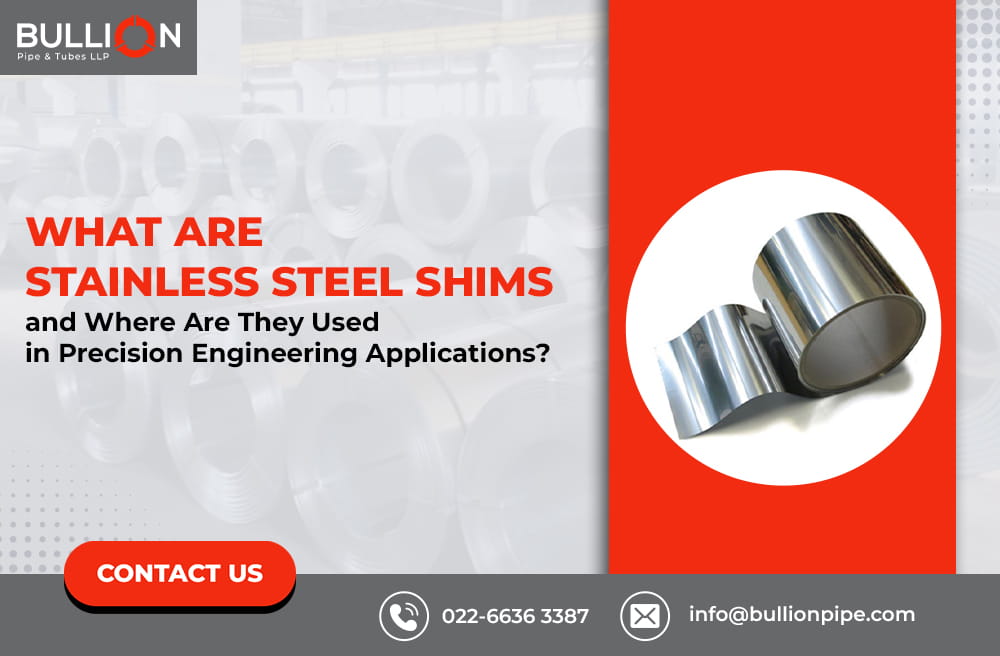
Stainless Steel Shims are thin sections of stainless steel material used to create gaps, spacing, alignment, or set clearances between parts. They are produced in various thicknesses, shapes, and dimensions, depending on the specific engineering and industrial needs.
These shims are typically made from high-quality stainless steel grades 304, 316, or 321 stainless steel, depending on the application requirements and the environment in which they will be used.
The stainless steel shims are manufactured with a precision that is not seen in standard spacers and are designed to be used in applications where even a small adjustment can have a dramatic effect on the performance.
The stainless steel shims are equipped with the following features:
1. Excellent Corrosion Resistance
S. Stainless steel shims have the greatest benefit of being resistant to corrosion, rust, and oxidation. This is ideal for industrial use such as chemical plants, marine environments, moisture-rich applications, etc.
2. High Strength and Durability
Stainless steel has strong mechanical properties, which can resist greater pressure, heavy loads, and vibration, and will not be easy to deform under the conditions of heavy vibration and high pressure.
3. Precision Thickness Control
For precision engineering applications, very high tolerances must be met. Precision shims are precisely made to guarantee consistent and reliable performance.
4. Temperature Resistance
Some stainless steel types are suitable for handling very high temperatures, and these shims are used in very high heat industrial systems as well as in industrial machines.
5. Easy Installation
The stainless steel shims are light in weight and convenient to replace them or install them in the maintenance and alignment processes.
Stainless steel shims come in a variety of types.
There are several types of stainless steel shims, depending on industrial needs:
Flat Shims
The following are the most common types used for spacing and leveling.
Slotted Shims
Designed to be installed around bolts or shafts without full disassembly, but can be put on and taken off quickly.
Tapered Shims
Used for making angular adjustments and/or for making a gradual alignment correction.
Peelable Shims
Precisely made with a layer structure, which allows engineers to strip off layers to obtain a precise thickness.
Custom Precision Shims
Made to special project size and tolerances for special applications.
The significance of precision shims in the engineering industry.The importance of precision shims used in engineering.
In precision engineering, a misaligned part by just a millimetre or so can result in loss of efficiency, wear and failure. Precision shims help eliminate these issues by maintaining exact positioning between components.
They assist in:
Machinery alignment
Shaft positioning
Vibration reduction
Load balancing
Gap adjustment
Equipment calibration
Stainless steel shims help maintain equipment alignment, reduce equipment maintenance costs, and maximize equipment service life.
Stainless Steel Shims are also employed in precision engineering. Stainless Steel Shims are also used in precision engineering.
1. Aerospace Industry
Precision-engineered components are vital in the aerospace industry. In aircraft assembly, engine alignment, landing gear systems, and structural installations, where precise tolerances are essential, stainless steel shims are employed.
They exhibit high strength-to-weight ratios, which makes them ideal for use in aircraft and other applications where reliability and safety are crucial.
2. Automotive Manufacturing
In the automotive manufacturing industry, precision shims ensure correct assembly of engine components, gear systems, brake assemblies, and transmission parts.
The stainless steel shims are used by the manufacturers to reduce vibrations, enhance vehicle performance, and ensure dimensional accuracy during assembly.
3. Industrial Machinery
Heavy industrial equipment is frequently subjected to high stress and constant motion. A precision shim is used for aligning rotating equipment, pumps, compressors, turbines, conveyor systems, etc.
Well-aligned minimises friction and premature wear of the moving parts.
4. Power Generation Plants
In mechanical systems, turbines and generators at power plants, stainless steel shims are employed in exact positioning and stability under high temperature and pressure conditions.
5. Oil and Gas Industry
The oil and gas industry faces harsh conditions where corrosion is critical. Drilling machine, Pipeline, Valve, Offshore Platforms use stainless steel shims for precision alignment and structural support.
6. Marine Engineering
Moisture and salt water are constantly present in marine systems. Stainless steel shims are used in shipbuilding, propellers, and offshore systems and offer excellent corrosion resistance.
7. Medical Equipment Manufacturing
Medical machinery and diagnostic equipment must be tightly calibrated and aligned. In surgical instruments, imaging systems, and laboratory equipment, where precision is crucial, precision shims are employed.
8. Electronics and Semiconductor Industry
Present-day electronics fabrication requires sensitive equipment that needs extreme precision in positioning. Stainless steel shims are used for semiconductor machines and precision electronic systems to help with precision spacing and alignment.
Stainless Steel is chosen as a preference for shims due to the following reasons:
While there are a variety of materials that can be used to make shims, stainless steel is one of the most common and advantageous options due to its versatility, strength, and resistance to corrosion.
Compared to plastic or aluminum shims, stainless steel shims offer:
Better load-bearing capacity
Longer service life
The ability to resist chemical and moisture damage.Chemical and moisture resistance.
Improved dimensional stability
Using a superior material, it is able to outperform in extreme conditions.
These attributes render them well-suited for sectors where accuracy and dependability are paramount.
Selecting the proper stainless steel shims involves looking at several factors.
Several factors will determine the choice of the correct shim:
Material Grade
Select stainless steel grades for environmental conditions and temperature.
Thickness Accuracy
Make sure the shim thickness is conformable to the required tolerances for the application.
Load Conditions
Take into account the mechanical loads and stresses to which the shim will be subjected during operation.
Corrosion Exposure
In corrosive environments, 316 may be a higher grade of stainless steel used.
Custom Requirements
Some industries might need specially shaped or sized precision shims.
High-quality precision shims offer several advantages: Precision shims with high quality have several benefits:
Benefits that one can reap from investing in premium quality stainless steel shims:
Improved equipment efficiency
Reduced downtime
Better alignment accuracy
Enhanced safety
Lower maintenance expenses
Longer machinery lifespan
These benefits play a crucial role in enhancing the efficiency and productivity of precision engineering industries.
Stainless steel shims are small yet extremely important components in modern engineering and industrial systems. Their role in maintaining alignment, spacing, and calibration makes them essential in applications where precision is critical.
From aerospace and automotive manufacturing to power generation and medical equipment, stainless steel shims provide reliable performance under demanding conditions. Their strength, corrosion resistance, and dimensional accuracy make them the preferred choice for industries requiring dependable precision shims.
As industrial technologies continue to evolve, the demand for high-quality stainless steel shims will continue to grow, supporting advanced engineering systems that require maximum accuracy and operational efficiency.
SEO Optimised FAQs
1. What are stainless steel shims used for?
Stainless steel shims are used for spacing, alignment, leveling, and gap adjustment in machinery and engineering applications that require precise tolerances.
2. Why are precision shims important in industrial machinery?
Precision shims help maintain accurate alignment and reduce vibration, friction, and wear, improving machinery performance and lifespan.
3. Which stainless steel grade is best for shims?
Grades such as 304 and 316 stainless steel are commonly used for their excellent corrosion resistance, strength, and durability.
4. Are stainless steel shims suitable for high-temperature applications?
Yes, stainless steel shims can withstand high temperatures and are widely used in power plants, aerospace systems, and industrial equipment.
5. Where are stainless steel shims commonly used?
They are commonly used in aerospace, automotive, oil and gas, marine engineering, medical equipment, industrial machinery, and the electronics manufacturing industry.