
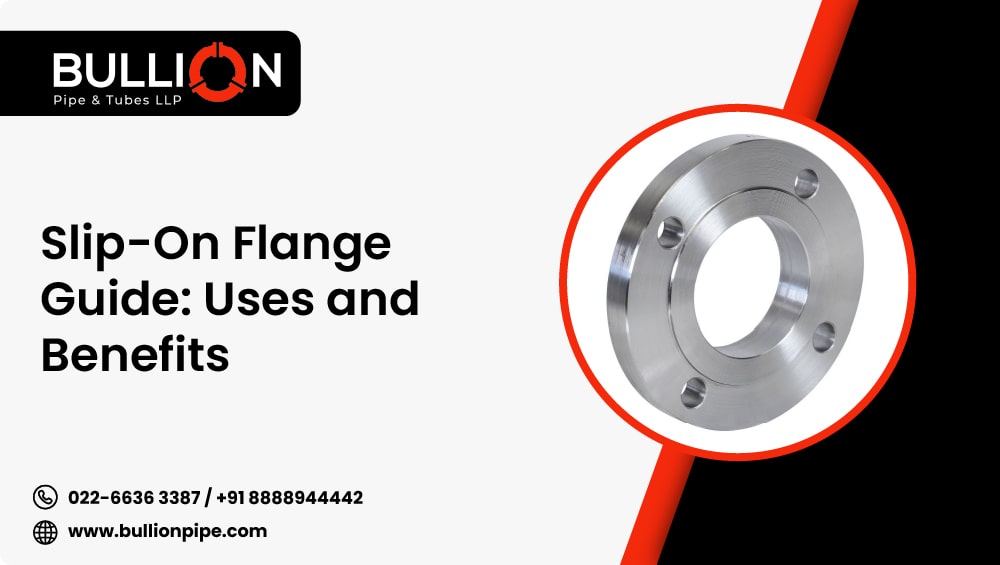
In industrial piping systems, the role of flanges is indispensable. They connect pipes, valves, pumps, and different equipment to form a leak-proof pipeline network. Among the various flange types available, the Slip-On Flange stands out as one of the most versatile and commonly used components. It is known for its
- Simplicity
- Cost-value
- Freedom of installation
The Slip-On Flange is used across industries ranging from oil and gas to water treatment and chemical processing.
This article on Bullion Pipe provides a detailed grasp of Slip-On Flanges—their
- Design
- Traits
- Uses
- Value—and why choosing the appropriate Slip-On Flange Supplier or Slip-On Flange Manufacturer in India can make a significant difference in performance and validity.
What is a Slip-On Flange?
A Slip-On Flange is a circular metal ring that slides over the closure of a pipe and is then welded in place. Unlike welding neck flanges, which have a long tapered hub, Slip-On Flanges are developed with a shorter hub, making them thinner and simpler to adjust during installation.
The flange “slips on” to the pipe, hence the name. It is then welded both inside and outside to provide strength and ban leaks. This double-welded connection gives the flange
- Structural integrity
- Ensuring reliable performance
- Best in moderate-pressure
- Excellent in low-temperature applications
Slip-On Flanges are typically on tap with a variety of substances, such as
- Stainless steel
- Carbon steel
- Alloy steel
- Nickel alloys
Design Components of Slip-On Flanges
Slip-On Flanges are manufactured according to international standards like
- ASME B16.5
- DIN
- EN
- BS
Their design ensures a valid fit and a strong mechanical connection between pipes.
Key aspects incorporate:
Raised or Flat Face Options: Slip-On Flanges can be supplied with a raised face for improved sealing performance or a flat face for non-critical applications.
Hub Design: The shorter hub provides compactness and allows straightforward adjustment.
Bolt Holes: Flawlessly drilled holes confirm true bolt placement during the meeting.
Weld Neck Preparation: The flange bore is barely more expansive than the outer diameter of the pipe to enable the possibility of it slipping over readily, previous to welding.
Due to their easy design, Slip-On Flange Manufacturers in India can develop them in a wide range of sizes and pressure ratings, from Class 150 up to Class 2500.
Manufacturing Method
The production of a Slip-On Flange involves several precise steps to guarantee realness, accuracy, and dimensional truth:
- Machining: The flange undergoes machining to achieve a certain thickness, bore size, and bolt hole synchronisation.
- Heat Treatment: This system increases the mechanical traits and durability of the flange.
- Inspection and Testing: Final inspection includes dimensional checks, ultrasonic testing, and pressure testing to ensure obedience with standards.
A trusted Slip-On Flange Stockist ensures any product undergoes thorough testing previously being dispatched, maintaining the integrity of industrial operations.
Commonly used tools:
Stainless Steel Slip-On Flange: Ideal for corrosive environments and chemical industries.
Carbon Steel Slip-On Flange: Proper for ordinary aspiration applications, including oil and gas pipelines.
Alloy Steel Slip-On Flange: Preferred for high-temperature and high-pressure systems.
Duplex and Super Duplex Steel Flanges: Used in marine and offshore applications for optimal corrosion resistance.
Nickel Alloy Flanges: Designed for overwhelmingly intense environments involving acids and high temperatures.
Applications of Slip-On Flanges
They are ideal for moderate-pressure pipelines and non-critical services. Some key industries that use these flanges include:
1. Oil and Gas Industry: For
- Connecting pipelines
- Valves
- Pumps that transport
- Crude oil
- Gas
- Petrochemical fluids
2. Chemical and Petrochemical Plants: To deal with
- Corrosive chemicals
- Safety
- Productivity
3. Water Treatment and Desalination Plants: For transporting treated and raw water
4. Expertise Generation Plants: In
- Steam lines
- Cooling water systems
- Condensers
5. Shipbuilding and Marine Building: Due to their corrosion resistance and ease of replacement.
6. Food and Beverage Industry: For sanitary pipelines that require frequent cleaning.
Advantages of Slip-On Flanges
Slip-On Flanges are preferred for valuable reasons. They offer a unique combination of cost streamlining, flexibility, and comfort of use. Here are the key advantages:
1. Beginner-friendly Installation:
The Slip-On Flange slides smoothly over the pipe, simplifying arrangement and positioning. It is ideal for systems where welding truthfulness is not critical.
2. Low Cost:
Slip-On Flanges require less material and welding, reducing installation costs.
3. Condensed Design
Their small hub and lightweight design save space and make handling more straightforward during organisation.
4. Versatility:
Suitable for a wide range of
- Pipe sizes
- Pressure ratings
This makes them one of the most flexible and easily accessible flange options.
5. Calm of Maintenance:
Since the flanges can be painlessly removed and reinstalled, maintenance and inspection are basic.
Choosing the Perfect Slip-On Flange Supplier
Selecting a Slip-On Flange Supplier is critical to ensure
- Product quality
- Safety
- Longevity
When estimating suppliers, consider the following factors:
Certifications and Cooperation: The supplier should meet international standards like
- ASME
- ASTM
- DIN
- ISO
Manufacturing Capabilities: The supplier should offer a range of
- Sizes
- Pressure ratings
- Assets
Testing and Inspection: Reliable suppliers perform
- Non-destructive testing (NDT)
- Hydrostatic testing before delivery
Global Reach and Openness: A Slip-On Flange Stockist with a wide inventory ensures timely delivery and a steady supply.
Customer Backup: Technical service and after-sales service are pivotal for long-term partnerships.
India is home to several eminent Slip-On Flange Manufacturers known for fidelity, manufacturing, economy, and support for international quality.
Slip-On Flanges vs. Other Flange Types
While Slip-On Flanges are extraordinarily famous, it’s important to understand how they relate to alternative flange types:
Weld Neck Flanges: Provide a preferred resource and are preferred for high-pressure systems; on the other hand, they are more costly and harder to install.
Socket Weld Flanges: Efficient for smaller pipe sizes and high-pressure systems
Lap Joint Flanges: Similar to Slip-On Flanges, however are used with a stub conclusion and are ideal for systems that require frequent dismantling.
Slip-On Flanges strike the correct balance between cost, performance, and lightness of installation, largely for moderate-pressure applications.
Future Patterns in Slip-On Flange Manufacturing
Developing patterns add:
Use of Duplex and Super Duplex Steels for advanced corrosion resistance.
Custom Coatings, such as PTFE and epoxy, to increase service life.
3D Modelling and Simulation for design optimisation.
Digital Traceability Systems for higher-quality food.
These innovations validate that Slip-On Flanges remain integral to changing industrial infrastructure.