
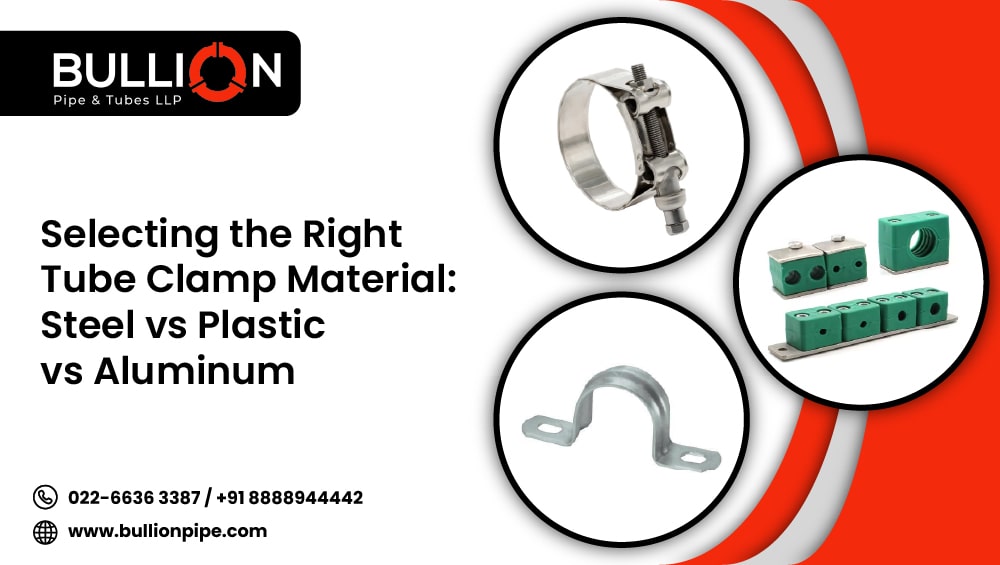
Bullion Pipe is one of the most trusted tube clamp material suppliers in India and all over the world. Based on our expertise, we believe that hydraulic systems are the main support of many industrial and construction operations. Whether in heavy machinery, offshore rigs, manufacturing plants, or pressurized control systems, hydraulic lines carry high pressures and often dynamic loads. In such environments, ensuring that hydraulic piping and tubing remain stable, harmonized, and protected is critical for both safety and performance. That’s where hydraulic tube clamps, pipe & tube clamps, and industrial pipe upholds play a central role.
Why Tube Clamps Matter in Hydraulic Systems?
Without achieving and properly developing clamping and copying, hydraulic tubing can suffer from:
- Vibration, fatigue, or cyclic stress
- Misalignment, shaping, or deflection
- Wear (cut) at tie points
- Potentiality leaks or failure at joints
- Resonance magnification under pulsation
- Danger to personnel or connected equipment
By securing tubes and pipes firmly, clamps disallow movement, reduce stress on fittings, sponge vibration, and protect against contrary mechanical damage. According to Tork Clamps, pipe clamps are vital for preventing displacement and leaks, thereby maintaining approach stability and reducing incident risk.
Additionally, as Piping Now emphasizes, clamps “hold pipes securely, disallow movement, and minimize stress on contacts,” which is important when temperature replacements, pressure cycles, or externalized powers are involved.
In hydraulic systems, tube clamps serve as a primary line of defense to protect high-pressure lines and ensure approach longevity.
Types & Design Elements of Tube Clamps & Encourages
Let’s explore the general variants and design aspects:
1. Standard / Single-Band Pipe & Tube Clamps
These are conventional clamps that wrap around a pipe or tube and are tightened using bolts, screws, or band mechanisms. They are accurate for fixed supports or when minimal movement is planned. Grainger offers a variety of tube & pipe routing clamps and promotes stabilizing runs, and excludes direct surface contact.
2. Hydraulic Tube Clamps & Hydraulic Copy Clamps
Some clamps are specialized for hydraulic lines, shaped with identified details: rubber or elastomer inserts to buffer vibration, definite inner diameters for a comfortable fit without crushing the tube, and sometimes modularity for clear-cut retrofit. STAUFF, a recognized brand, supplies clamps for hydraulic pipes and hoses with vibration-reducing attributes, along with DIN 3015 standards.
Manufacturers often engineer “hydraulic clamp systems” to mount hydraulic lines and backup breakpoint fittings in a controlled manner.
3. Heavy-Duty Tube Clamp
For high-load or high-vibration applications, heavy-duty clamps are key. These are robustly made from thicker steel, stainless steel, or alloy, sometimes with other enhancements. Tork’s product line includes a DG5 Heavy Duty Pipe Clamp option for demanding use cases. A heavy-duty tube clamp must resist deformation under load and maintain a tight grip under shock or cyclic factors.
4. Split / Two-Piece Clamps / Split Ring Clamps
These clamps can be opened and installed around an existing pipeline without needing to dismantle the run. They are ideal where retrofitting or maintenance is fundamental. The “split ring hanger” design is casual in pipe hanger systems, offering the ease of installation and support.
5. Guides, Supports & Hangers as Matching Cures
Clamps are often connected with promoters, guides, and hangers as part of a holistic backup system. Pipe reinforcements (saddles, rollers, and spring assists) help carry weight, host movement, and prohibit sag. Buckaroos outlines multiple copy types used along with clamps to handle loads, movement, and vibration. Eaton’s pipe hanger catalogue furthermore covers elements, load issues, and excellent implementations for supporting pipelines.
Key Design & Categorization Standards
When choosing or designing tube clamps and champions for hydraulic systems, consider the following:
a) Material compatibility and corrosion resistance
Clamps should ideally be of the same or an appropriate material as the tubing to escape galvanic corrosion or disparity in thermal expansion. Stainless steel, treated carbon steel, or coated elements are usually used in bold or outdoor environments. Eaton’s principles accentuate material grouping for corrosion and long-term durability.
b) Vibration dampening & cushioning
Using rubber or elastomer inserts inside clamps helps capture vibration and prevents a metal-to-metal connection, reducing wear. Many hydraulic clamps add such liners to buffer the tubing.
c) Load rating & property
Clamps and champions should house the weight of the fluid-filled tubes, plus dynamic loads, influence strengths, and thermal growth. Overengineering is safer than undersizing.
d) Spacing and layout
Clamp spacing depends on tube diameter, wall rigidity, and hoped-for foreign forces. Closer spacing helps reduce sag and vibration. Piping substitute directions outline the finest spacing to maintain conformity.
e) Peace of maintenance/ease
Split clamps, modular systems, or clamps with removable liners facilitate maintenance, inspection, and replacement without dismantling the intact line.
f) Standards agreement
Many industries use standards like DIN 3015 for pipe/hose clamps and fenders. STAUFF clamps, for illustration, comply with DIN 3015. Using standardised clamps ensures quality, interchangeability, and predictable performance.
g) Thermal and mechanical movement allocation
Specifically in hydraulic systems with temperature swings, clamps must allow for thermal growth/contraction without imposing unreasonable stress on tubes or joints.
Role of the Tube Clamp Manufacturer & Quality Dependence
A reputable tube clamp manufacturer will not just offer off-the-shelf clamps but also help with custom designs, asset arrangement, creation support, and testing. Key elements to look for in a manufacturer:
Cooperation with contextual standards (DIN, ISO, ASME)
Exacting quality inspection (material, scale, fatigue, corrosion)
Talent to provide application-precise cures (vibration damping, modular systems)
Supportive after-sales service, spare parts, replacement liners
Documentation, traceability, certificates
Choosing a trusted manufacturer ensures that your hydraulic operation’s stability isn’t compromised by substandard clamps.
Safety & Stability in Practice: Finest Practices
1. Use clamps at all changes in direction or copy points
Bends, tees, or direction amendments generate pressures; clamps should cornerstone the tubes hence.
2. Utilize differential clamping
In long runs, use anchors and guides to control thermal spread and avoid inducing stress at clamps.
3. Escape over-tightening
Over-tightened clamps can deform tubing or impose undue stress — assure identified torque and use cushioned liners.
4. Gradual inspection and preventive maintenance
Vibration, corrosion, or mechanical fatigue may degrade clamps over time — scheduled inspections block failures.
5. Redundancy for critical lines
In high-consequence systems, consider dual clamps or optional champions as support.
6. Add dynamic load factors in design
Hydraulic surges or pressure shock can impose transient forces; clamps must be rated, therefore.
7. Use an exact substitute joining
Clamps should work with reinforcements (saddles, spring endorses) to balance load, movement space, and stability.
Credible-World Use Cases & Data
STAUFF is vaguely accepted in hydraulic systems for pipes and hoses, with vibration and noise dampening built into designs.
Modular clamp systems (e.g. DIN 3015 style) are used in industrial settings to allow reconfiguration and smoothness of replacement.
Tork Clamps enhance safety in industrial environments, stressing how pipe & tube clamps block displacement and leaks, reducing risk.
The Hydac modular mounting clamp systems (DIN 3015) are widely used in hydraulic and pneumatic line installations to carry static and dynamic loads.
These examples highlight how advantageous clamp design contributes to safer, more reliable hydraulic installations.
FAQs
1. What is the difference in relation to a hydraulic tube clamp and an ongoing pipe clamp?
A hydraulic tube clamp is expressly crafted for high-pressure hydraulic lines. It often includes tight tolerances, cushioning liners, vibration damping, and modular designs to provide for small-diameter tubing and dynamic loads. A continuous pipe clamp may be more generic and less optimized for the demands of hydraulic systems.
2. How does a heavy-duty tube clamp differ from standard clamps?
A heavy-duty tube clamp is built from thicker, stronger assets (e.g., heavy steel, reinforced alloys), developed to handle higher loads, shocks, or cyclic stresses. It resists deformation and maintains grip in more offensive environments, making it well-suited for high-stress or critical hydraulic routes.
3. Can tube clamps plus react as hydraulic backup clamps?
Yes — many tube clamps double as hydraulic support clamps, meaning that they not only grip the tubing on the other hand beyond mainstay, reserve and position it as part of the operation’s structural reserve layout. When properly chosen, a single clamp can perform both constraining and supporting roles.
4. How should I select a tube clamp manufacturer?
Look for a manufacturer who:
Complies with important standards (DIN, ISO, ANSI)
Offers high-quality tools and corrosion resistance
Provides application mechanics copy
Supplies modular/customizable clamp systems
Offers spare parts, liners, and maintenance backup
Provides affirmation, traceability, and quality documentation
5. What spacing guidelines are implemented by Bullion Pipe for industrial pipe supports and tube clamps in hydraulic systems?
Spacing depends on tube diameter, wall thickness, and assumed loads. As a rule, supports/clamps are placed more persistently for smaller diameters or flexible runs. For more extensive or heavier tubes, the distance may become higher, yet it should permanently outlaw sagging or excessive vibration. Refer to piping substitute standards or manufacturer guidelines — e.g., Eaton’s pipe hanger catalogue provides reserve spacing and load data.