
The oil and gas industry operates in some of the most exacting environments, where clarity, performance, and safety are paramount. One of the most critical, yet still often overlooked, components in this sector is industrial strainers. These devices guarantee
- Smooth operations
- Protects pricey downstream equipment
- Damage caused by debris
- Contaminants
- Unwanted particles.
From upstream adventure to downstream upgrading, filtration plays a noteworthy role in maintaining involved integrity. Among the many methods accessible, case strainers, Y strainers for the oil industry, and extra pipeline strainers are indispensable for ensuring successful oil & gas filtration. In this blog, we will discuss the importance of strainers, their types, applications, and why choosing the exact strainer manufacturer matters for long-term success.
Why Do Industrial Strainers Matter in Oil & Gas Filtration?
Pipelines, compressors, pumps, valves, and turbines are the core of the oil and gas industry. In spite of that, these components are resistant to damage caused by dirt, scale, rust, welding slag, sand, and other foreign matter. Left unchecked, contaminants can lead to:
- Restricted pipelines
- Reduced flow productivity
- Diminution of pumps
- Damage to valves
- Unplanned downtime
- Costly repairs
- Safety risks in high-pressure operations
By installing the exact industrial strainer at critical points, operators can ensure endless flow, minimise equipment wear, and add to the lifecycle of expensive machinery. Simply put, strainers act as the first line of defence in any oil & gas filtration system.
Types of Industrial Strainers Used in Oil & Gas
Different oil and gas applications demand different filtration answers. The most normal pipeline strainers include:
1. Cage Strainer
A carton strainer is crafted to capture great quantities of debris and is ideal for applications requiring uninterrupted operation. It features a removable mesh cage that can be effortlessly cleaned or replaced.
Advantages:
- High dirt-holding potential
- Beginner-friendly maintenance
- Customisable mesh sizes.
Applications:
- Protecting pumps
- Compressors
- Heat exchangers in refineries
- Different offshore platforms.
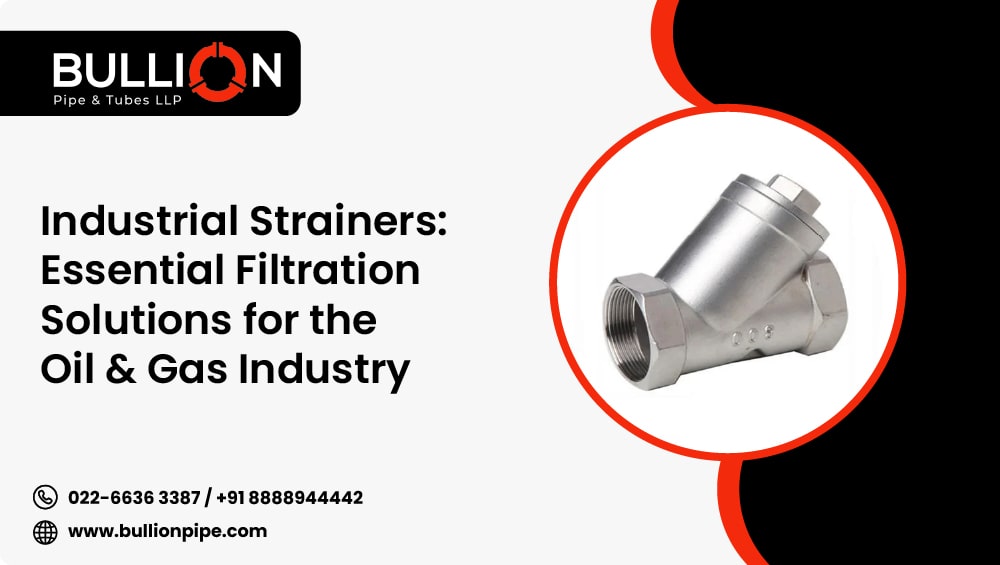
2. Y Strainer
Y strainers for the oil industry are quick, lightweight, and shaped to handle high-pressure and high-temperature restrictions. They are shaped like the letter “Y”, making them fitting for both horizontal and vertical installations.
Advantages: Space-saving design, low maintenance, and fantastic for small particle filtration.
Applications: Used in fuel lines, gas pipelines, and steam applications where fine filtration is necessary.
3. T Strainer
A T-type pipeline strainer combines the benefits of cage and Y strainers, offering higher flowability while being terse.
Advantages
- Organised filtration
- Trouble-free customisation
- Long service life.
Applications
- Offshore drilling operations
- Petrochemical plants
- Natural gas pipelines.
4. Duplex Strainer
Duplex or twin-basket strainers are intended for continuous operations.
They consist of
- Two filtration chambers
- Grants one basket to observance while the other is cleaned.
Advantages
- Zero downtime
- Ongoing filtration
- Durability.
Applications:
- Offshore rigs
- LNG plants
- Large refinery units.
Key Good outcomes of Using Pipeline Strainers in Oil & Gas
Uniting strainers into pipeline systems provides numerous energetic and financial benefits:
1. Protects Equipment – Prevents damage to critical components like turbines, valves, and compressors.
2. Reduces Downtime – Cleaner pipelines mean fewer shutdowns and less frequent maintenance.
3. Improves Proficiency – Ensures excellent fluid flow, reducing vigour costs.
4. Extends Equipment Life – Minimises wear and tear caused by cutting particles.
5. Raises Safety – Reduces risks connected with pipeline failures and equipment malfunctions.
Applications of Industrial Strainers in Oil & Gas Filtration
Industrial strainers are critical across every stage of the oil and gas value chain. Some key applications add:
Study and Production
Removing
- Sand
- Silt
- Separate particulates from savage oil and drilling mud.
Transportation & Storage
Protecting
- Pumps
- Compressors in pipelines that transport
- Crude oil
- Natural gas.
Increasing & Distribution
Filtering contaminants at an earlier time viciously enters:
- Improving units
- Ensuring blank fuels during final processing.
Offshore Platforms
Safeguarding
- Seawater injection systems
- Cooling water systems from marine debris.
Petrochemical Plants
Ensuring smooth operation of chemical reactors by removing contaminants from feedstock.
Choosing the Exact Strainer Manufacturer
With so much at stake in the oil and gas industry, partnering with a reliable strainer manufacturer is essential. Here are some qualities to look for:
1. Material Talent: The manufacturer should provide strainers made from high-score tools like stainless steel, carbon steel, or duplex alloys to withstand corrosive environments.
2. Customization: Separately, pipeline steps have unique needs, so the manufacturer should offer tailor-established options in terms of mesh size, pressure rating, and connection type.
3. Conformity & Certification: Look for products that comply with international standards such as ASME, API, and ISO.
4. After-Sales Support: Reliable technical copy and spare part attainability are critical for long-term operations.
5. Proven Track Record: Go with a manufacturer with expertise supplying to global oil and gas tasks.
Future Tendencies in Oil & Gas Filtration
As the oil and gas industry evolves, so does filtration technology. Some evolving tendencies mix:
Smart Strainers: Fusion of sensors to monitor clogging layers and predict maintenance needs.
Modern Elements: Use of super duplex stainless steel and corrosion-resistant alloys for longer service life.
Eco-Amiable Designs: Expansion of strainers that minimise waste and backup maintainable operations.
Modernisation: Robotic cleaning systems to reduce manual intervention and align safety.
Conclusion
In an industry where the smallest contaminant can consistently cause million-dollar losses, industrial strainers are not optional—they are key. Whether it’s a box strainer protecting refinery pumps or Y strainers for the oil industry ensuring vacant fuel flow, these pipeline strainers are indispensable for competent oil & gas filtration.
By choosing the right strainer manufacturer and investing in quality strainers, oil and gas operators can reach
- Better bonds
- Reduce downtime
- Safeguard both equipment and personnel.
As technology advances, strainers will continue to
- Transform
- Playing a smoother
- A more advanced role in the following way in the oil and gas sector:
- Ensuring the stability
- Focus on Adaptability