
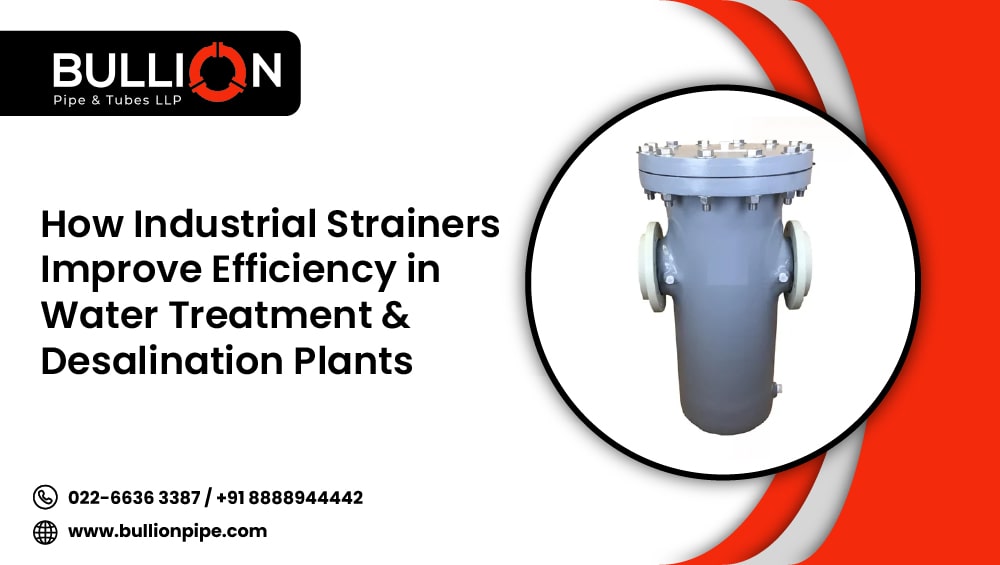
Bullion Pipe is a reputed dealer of industrial strainers. We believe that in water treatment and desalination plants, one of the most critical challenges is managing suspended solids, debris, and particulate matter. These materials can damage downstream equipment, foul membranes, and reduce system throughput. Industrial strainers serve as the front-line defence to trap and remove coarse contaminants. They protect pumps, membranes, heat exchangers, and extra-critical components.
When properly selected and executed, industrial strainers can substantially
- Amplify total plant capability
- Reduce maintenance
- Lower productive costs.
The Role of Industrial Strainers in Water Treatment & Desalination
Industrial strainers for water treatment are mechanical devices installed upstream in pipelines to filter out more extensive particles (sand, scale, rust, and biological debris). Unlike fine filters that catch definitely small particles, strainers perform as “coarse filters” to exclude giant objects from damaging or clogging downstream equipment. According to a guide on industrial strainers, they are used to prevent blockages and protect pumps, valves, and instrumentation.
In desalination plants, seawater strainers are predominantly critical in the intake stage, where raw seawater is drawn in. These strainers remove the following from further treatment or reverse osmosis (RO) stages:
- Debris
- Plankton
- Seaweed
- Sediment
- Macro-organisms
Without productive strainers, RO membranes are at risk of
- Fouling
- Physical damage
- Increases energy consumption
- Boosts maintenance frequency.
Key Rewards: Performance, Guard & Cost Savings
1. Reduced fouling and membrane damage
By removing important particles ahead of time, strainers reduce the load on
- Downstream filters
- Membranes.
This aspects benefits in the following ways:
- Reduces cleaning cycles
- Lowers fouling rates,
- Extends membrane life.
2. Lower pressure drop and vigor consumption
A well-designed strainer with faultless mesh or perforation size maintains a low pressure drop, which means pumps do not need to work harder. Automatic self-cleaning strainers help maintain uninterrupted differential pressure, avoiding the rise in stamina use that comes with clogged static strainers. For desalination usage, self-operating self-cleaning filters have been shown to reduce active costs by ensuring a low and stable differential pressure across the screening component.
3. Perpetual operation & minimal downtime
Historic box or Y-type strainers require periodic shutdowns for cleaning. Duplex strainer designs and mechanical self-cleaning strainers grant cleaning or backwash while flow continues, thereby eliminating unplanned outages. For instance, duplex strainers permit access to one chamber to become isolated and cleaned while the other remains in service.
4. Extended equipment life
Removing grit from the meeting protects pumps, valves, and piping from degradation and wear. Over time, this promotes the longevity of costly components and reduces repair or replacement costs.
5. Preferred method of control and perfection
With stable feedwater quality and fewer disruptions, plants can operate closer to design stages, improving the meeting of production targets and water quality standards.
Types of Strainers & Their Suitability for Water Treatment/Desalination
To achieve these good outcomes in practice, one needs to understand various strainer types and how they are put to use in water treatment and desalination settings.
1. Basket Strainers
These are among the simplest and most robust types. A perforated or wire mesh basket traps solids, and the case must be taken out and cleaned. Box strainers are extensively used across water treatment applications for their simplicity. Except that they require downtime for cleaning, they are less ideal for persistent flow systems unless connected with a duplex structure.
2. Y-Strainers
Shaped like a Y, where the strainer segment is branched off, these are succinct and suited to smaller pipelines. They are commonly used where space is constrained. Although cleaning them requires a shutdown or bypass.
3. Duplex Strainers (Double Carton)
Duplex strainers attach two parallel baskets. Operators can switch the flow from one chamber to the other during cleaning. This ensures incessant flow—a major benefit in desalination plants or critical water supply systems.
4. Self-driven Self-cleaning Strainers/Filters
These are more cutting-edge systems that automatically flush or backwash themselves when a differential pressure threshold is reached—no stopping the flow, no manual cleaning necessary. They may use sensor triggers, motorised backwash valves, brushes, or nozzles to hollow out debris. Mechanical self-cleaning strainers are exceptionally rewarding in seawater intake lines and RO pre-treatment, maintaining stable performance with minimal operator intervention.
There are, over and above that, regulated designs for seawater cooling systems that reduce repair time (TTR) from hours to minutes by automating cleaning.
5. Stainless Steel Strainers
Because many treatment and desalination systems bond with corrosive or saline environments, stainless steel strainers are often used to
- Resist corrosion
- Prolong service life.
Stainless steel meshes or perforated plates maintain structural integrity in harsh environments. Accordingly, improving the meeting options of screen filters and stainless steel strainers with flush-valve modernisation is simple in industrial water filtration.
Fulfillment Approaches
To maximise the performance of strainer filters in treatment or desalination environments, consider the following:
Proper mesh sizing: Decide on perforation or mesh sizes that balance particle removal with allowable pressure drop.
Bypass or parallel lines: Provide bypass or redundant paths so that maintenance or cleaning can be done without disrupting flow.
Differential pressure monitoring: Use pressure sensors to monitor ΔP and switch on cleaning cycles before back pressure becomes excessive.
Scheduled maintenance & inspection: In regular self-cleaning systems, periodic inspection is fundamental to confirm mechanical integrity and address debris growth or wear.
Material arrangement: In seawater or corrosive environments, prefer stainless steel or corrosion-resistant alloys for housings and internals.
Reserve cleaning schemes: Exceptionally, for systems with heavy debris loads or seasonal modifications, manual or supplementary cleaning access should become obtainable.
Original-World Evidence of Optimization Gains
One pilot carrying out automated self-cleaning screens in a seawater desalination plant showed that with self-driven flushing, such filters can maintain filtrate quality while incurring great savings in drive, manpower, and consumables compared to disposable cartridge filters. Similarly, relative to cartridge filters, which clog and require frequent swaps, self-driven filters maintain a lower and more stable differential pressure, reducing OPEX.
In a new study, a refined automated cleaning strainer in a coastal power plant’s seawater cooling procedure reduced the time to repair (TTR) from ~3 hours to just 5 minutes, upgrading plant performance and reliability. Such results highlight how a remarkable strainer design can deliver concrete, vigorous gains.
Challenges & Mitigation
While strainers offer many upsides, some challenges must be addressed:
Clogging under heavy loads: An Unusual debris load can:
- Increase the strainer potential
- Cause oversizing
- Lead to ineffective filtration
High initial cost: Self-operating and duplex systems cost more upfront, though lifecycle savings often justify them over time.
Mechanical difficulty and maintenance: Computerized systems introduce mechanical elements that must be clearly maintained.
Corrosion, scrapes & wear: uniquely in seawater, material deterioration must be monitored—for this reason, stainless steel construction is essential.
Nonetheless, when properly fabricated, industrial strainers from reputed companies like Bullion Pipe distinctively fine-tune flow, reduce unexpected downtime, protect critical assets, and contribute to higher step-throughput with lower overall costs.
FAQs
1. What is the difference relative to water filtration strainers and fine filters?
Water filtration strainers (or industrial strainers for water treatment) are created to remove more expansive particles and debris (e.g., sand, twigs) earlier before fluid entry to superior filtration or membrane stages. Fine filters or membrane filters (e.g., RO membranes) remove much smaller particles and contaminants. Strainers protect downstream equipment and broaden filter life.
2. How do mechanical self-cleaning strainers work, and why are they facilitating?
Automatic self-cleaning strainers monitor the pressure differential across the strainer. When it exceeds a preset threshold, a cleaning cycle (via brushes, backwash jets, and flush valves) is activated automatically—without stopping flow. This ensures perpetual operation, avoids manual maintenance, and maintains a low pressure drop.
3. When should I decide on a duplex strainer over a single storage box or Y-strainer?
A duplex strainer is ideal when a procedure connection is critical. While one chamber is cleaned or serviced, the alternative remains in operation. This eliminates downtime associated with cleaning. In nonstop water treatment or desalination systems, duplex strainers provide redundancy and continual flow.
4. Are stainless steel strainers well-suited for seawater applications?
Yes. In corrosive or saline environments, stainless steel strainers are a preferred choice due to their corrosion resistance and durability. Using stainless steel for both housing and mesh/perforated elements helps assure a long service life balanced under intense seawater conditions.
5. How much proficiency can a desalination plant obtain by using strainers?
Effectiveness in step design and framework limitations, though credible real-world case studies show material good outcomes:
In a desalination pilot, automated self-cleaning screens reduced operating costs (vitality, manpower, consumables) compared to cartridge filters.