
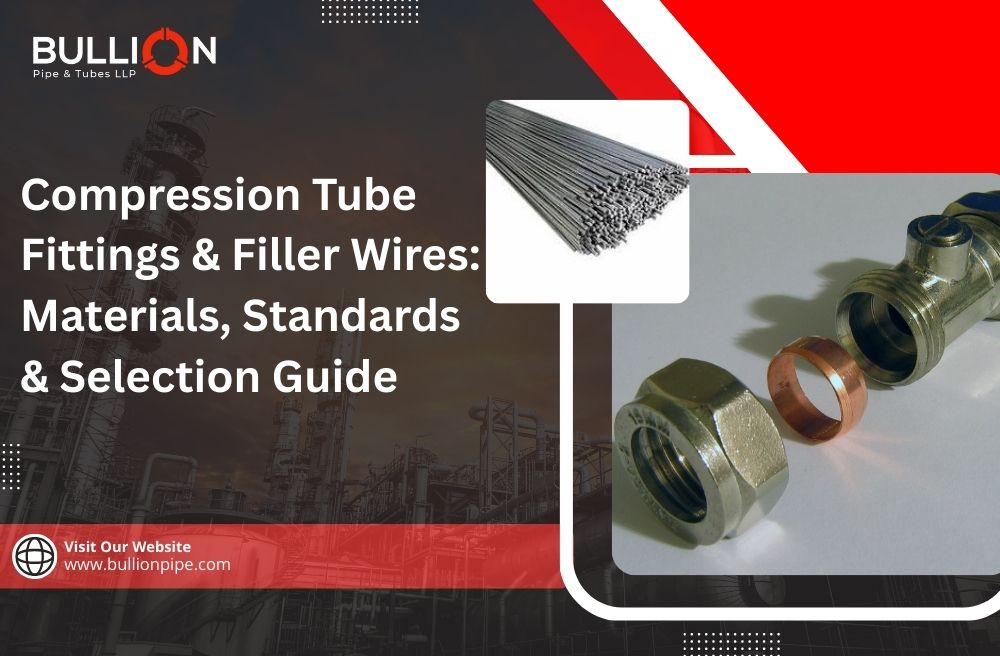
In industrial pipelines, fluid transfer or fabrication, compression tube fittings and filler wires are essential, but undervalued functions. From oil and gas plant or chemical processing equipment, to manufacturing systems for HVAC and fine fabrication. The proper choice of these parts directly affects the safety of leaks as well as leak-prevention corrosion resistance, as well as longevity.
We at Bullion Pipe a leading Compression Tube Fittings & Filler Wires Supplier in India offer you this comprehensive guide explaining the different materials, standards worldwide and the best way to select the appropriate compression fittings.
What is Compression Tube Fittings?
Compression fittings for tubes are connections made of metal that connect tubes without threading or welding. They function by putting a ferrule into the tube once they tighten the nuts making a solid seal that is leak-proof.
Essential Benefits of Compression Fittings
- There is no need for heat or welding
- Rapid installation and maintenance
- Seals that are reliable under pressure
- Ideal for high-temperature and corrosive environments
These fittings are commonly utilized for hydraulic systems as well as instrumentation pipelines, gas pipelines and for industrial pipelines for handling fluids..
Understanding Filler Wires and Fabrication
Filter wires can be consumable substances employed in brazing or welding to connect metals. Filler wires melt and then fill the joint, which ensures durability, strength as well as corrosion resistance and metallurgical compatibility.
Common Uses of Filler Wires
- Pipe welding and tube welding
- Pressure vessel fabrication
- Boilers and heat exchangers
- Precision and structural welding
Selecting the right filler wire is as important as choosing the correct fitting material.
Materials used to make Compression Tube Fittings
Compression Fittings made of Stainless Steel
- Excellent corrosion resistance
- High strength at high temperatures
- Common grades: SS 304, SS 316, SS 316L
- The ideal environment for chemical, pharmaceutical and marine environments.
Carbon Steel Compression Fittings
- High mechanical strength
- Cost-effective in non-corrosive environments
- Most often, it is used in hydraulic and oilfield applications
Brass Compression Fittings
- Good resistance to corrosion in moderate environments.
- It is easy to machine and set up
- In Plumbing, HVAC and distribution of gas
Materials used in filler Wires
Stainless Steel Filler Wires
- Compatible with SS base metals
- In food production, chemical facilities and in pharma
- Popular grades: ER308L, ER316L
Carbon Steel Filler Wires
- Useful for structural and pressure applications.
- Outstanding tensile strength and weldability
Nickel & Alloy Filler Wires
- It is designed for high-temperature and corrosive conditions
- In energy plants, refineries and aerospace
International Standards You Should Know
Compression Tube Standard for Fitting
- ASTM – Specifications for material and dimensional requirements
- ASME — Performance and pressure standards
- DIN / ISO – European dimensional and quality norms
- BSC – British tubing and piping standards
Filler Wire Standards
- AWS (American Welding Society) – Classification of filler metals
- ASTM A5 Series – Chemical composition as well as mechanical properties
- EN ISO – European welding consumable standards
Conforming to recognized standards will ensure the interchangeability of standards in safety, compliance with standards, and worldwide acceptance.
How to Choose the Right Compression Tube Fittings
1. Operating Pressure and Temperature
Always ensure that the fitting material is matched to the system’s pressure and operating temperature in order to prevent the failure of the seal.
2. Media Compatibility
Test resistance against gas, chemicals, oil, steam, or other substances that are flowing through the system.
3. Tube Material & Size
Compression fittings need to be compatible with tube diameter wall thickness, tube OD, and metallurgical properties.
4. Installation Environment
Think about vibration as well as thermal cycling and exposure to corrosive or moist atmospheric conditions.
How to Choose the Correct Filler Wire
1. Base Metal Compatibility
The filler wire must match or enhance the metal’s composition.
2. Welding Process
Choose filler wires that are specifically for MIG, TIG or manual welding.
3. Specifications for Strength and Corrosion
Highly corrosive or high-stress environments require high-carbon filler wires that are alloyed or low carbon.
4. Industry Compliance
Make sure the filler wire is in compliance with The AWS specifications, ASTM and ISO specifications that are required for the project you are working on.
Compression Fittings and Welding What to use when?
| Criteria | Compression Fittings | Welding using Filler Wire |
| Installation | Quick and easy to remove | Permanent |
| Heating Input | None | Needed |
| Maintenance | Simple replacement | It is difficult |
| Strength | The High (mechanical seal) | High (metallurgical bond) |
A lot of industrial systems employ both according to availability and the performance requirements.
Compromiser tube fittings as well as filler wires can appear as small parts however they are the basis for the security, integrity and longevity in industrial equipment. Through understanding the materials, standards and the selection criteria both buyers and engineers are able to avoid failures, leaks and the costly downtime.
When you’re planning the new pipeline, enhancing fabrication processes, or searching for Industrial components, selecting the best fitting or filler wire for your needs is an option that can yield long-term benefits.
To get Premium Quality Compression Tube Fittings & Filler Wires at an affordable Compression Tube Fittings & Filler Wires Price in India you need to ‘Get in Touch’ with us at Bullion Pipe, a top Compression Tube Fittings & Filler Wires Manufacturer in India and ‘Get a Quote.