
In modern industrial infrastructures pipeline systems are the foundation of operations that span oil and gas, power plants, petrochemicals water treatment, as well as construction. Safety, efficacy and durability of these systems are largely dependent in the caliber of the components that are used, especially fittings. Of all the types on the marketplace, buttweld fittings stand out due to their extraordinary durability, strength and leak-proof properties.
For businesses like Bullionpipe that offer top-quality buttweld fittings ensures that pipelines can withstand extreme temperatures, pressures and environmental conditions with no failure. Let’s look at how fittings made of buttweld improve structural integrity and stop leaks in pipeline systems that are critical to the operation.
What Are Buttweld Fittings?
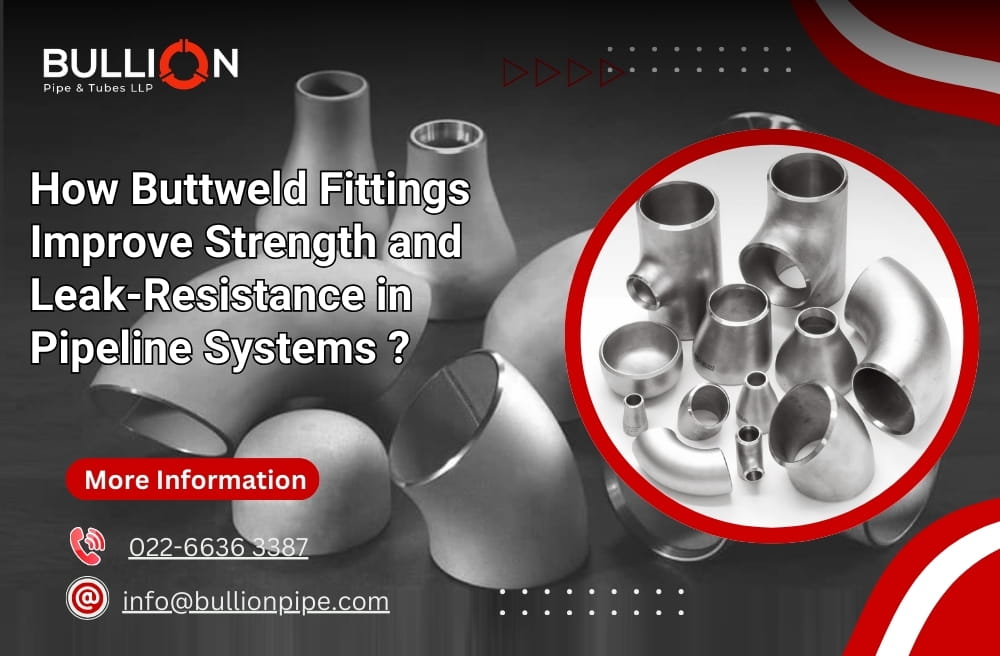
Buttweld fittings are fittings made to be welded directly to pipes with the butt welding process. This creates a long-lasting seamless connection between fittings and pipes. The most common types of fittings are:
- Elbows (45deg, 90deg, 180deg)
- Tees
- Reducers
- Caps
- Cross fittings
In contrast to socket or threaded fittings and fittings made of buttweld can be joined end-to-end to the pipe and form a seamless structure. This type of design greatly increases strength and resistance to leaks.
1. Seamless Welded Joint for Maximum Strength
The main benefit of fittings with buttwelds is the process of welding itself. While butt welding the edges of the fitting and pipe are beveled before being welded to create a sturdy continuous joint.
Why This Matters:
- Eliminates mechanical connections that are weak
- Creates uniform stress distribution
- Reduces the chance of joint failure.
Since the welded joint becomes part of the pipeline’s structure and is a part of the pipeline structure, it increases the overall strength of the pipeline. In high-pressure areas, such as gas transmission lines or oil refineries pipelines the strength of this joint is vital.
Bullionpipe assures the highest quality manufacturing of fittings for buttwelds to ensure that the wall thickness is accurate and tolerances for dimensionality, which directly impact joint integrity.
2. Superior Leak-Resistance Compared to Threaded Fittings
One of the greatest challenges with pipeline systems are leaks. Leaks can lead to:
- Product loss
- Environmental hazards
- Downtime during operations
- Risks to safety
In contrast to threaded fittings which depend on sealing compounds and gaskets. Buttweld fittings produce an entirely weld joint. This prevents gaps and thread clearances that allow leaks to form.
Key Leak-Resistance Advantages:
- No threaded connections
- No gasket failures
- There is no loosening caused by vibration.
- The risk of corrosion is reduced at joints
In industries that transport dangerous gases or fluids Buttweld fittings offer the security required to stop harmful and costly leaks.
3. Enhanced Flow Efficiency
Another way that buttweld fittings can improve the performance of pipelines is to provide smooth surfaces on the internal surface. Since the fitting is welded in a seamless fashion, there aren’t any internal obstructions, such as sockets or threads.
Benefits for Flow:
- Reducing Turbulence
- Lower pressure drop
- Increased efficiency of flow
- Reduction in energy consumption
For industries in which fluid dynamics are important, such as water distribution or chemical processing, smooth internal flow results in improved operational efficiency and less cost of pumping.
Bullionpipe manufactures fittings for buttwelds that are made with precise machining that ensures an even bore alignment and maximum flow performance.
4. High Pressure and Temperature Resistance
Pipeline systems at offshore rigs, power plants and petrochemical facilities work in extreme conditions. The components must be able to:
- Internal pressure is high
- Extreme temperatures
- Contraction and thermal expansion
- Mechanical tension
Buttweld fittings are specifically designed to be able to match the strength and quality of the pipes they join. If they are welded correctly they are able to withstand identical pressure ratings to the pipe itself.
These fittings are perfect for:
- Steam lines
- High-pressure gas pipelines
- Boiler systems
- Industrial processing plants
Bullionpipe offers buttweld fittings in different materials like stainless steel, carbon steel, alloy steel and duplex steel, to meet high-demanding requirements for applications.
5. Long-Term Durability and Reduced Maintenance
The cost of maintenance can have a significant impact on the profits of a business. The poor quality of fittings can cause:
- Frequent repairs
- Joint replacements
- Failures due to corrosion
- Production interruptions
Buttweld fittings last for a long time due to their welded structure and strength. Since there aren’t any mechanical threads or moving parts The risk of loosening or breaking is low.
Long-Term Benefits:
- Longer pipeline life
- Reduction in frequency of inspections
- Lower lifecycle costs
- Minimal downtime
By investing in top-quality buttweld fittings from trusted suppliers such as Bullionpipe businesses can reduce costs for maintenance and increase efficiency and reliability.
6. Better Performance Under Vibration and Mechanical Stress
Industrial pipeline systems typically experience vibrations caused by compressors, pumps, and other heavy equipment. Mechanical fittings or threaded fittings could be loosened over time in the course of constant vibration.
Buttweld fittings, which are permanently welded, can provide:
- Solid resistance to vibrating
- Stable structural alignment
- Reduction in mechanical fatigue
This makes them particularly suitable in offshore installations, factories and other heavy-duty tasks.
7. Flexibility in Design and Customization
Buttweld fittings are offered in a variety of wall thicknesses, sizes as well as pressure ratings. They can be tailored to the specifications of your project and international standards like:
- ASME
- ASTM
- ANSI
Bullionpipe guarantees compliance with international standards, which makes their fittings for buttwelds appropriate for projects both domestic and international.
8. Improved Structural Integrity of Pipeline Systems
If the pipeline joint is joined with buttweld fittings and the whole system functions as a single structure. This is beneficial:
- Capacity to bear load
- Resistance to external impacts
- Structural balance
This unification is particularly advantageous in underground pipelines and long-distance transmission networks.
Why Choose Bullionpipe for Buttweld Fittings?
Selecting the best manufacturer is as crucial as selecting the correct product. Bullionpipe is focused on:
- Strict quality control
- Precision manufacturing
- Material traceability
- Timely delivery
- Conformity to international standards
These fittings are engineered to withstand the rigors of use, strength and leak-proofing. This makes them perfect for crucial industrial applications.
Buttweld fittings play a crucial part in enhancing the strength and resistance to leaks in pipelines. They have seamless welded joints. high pressure tolerance and smooth flow characteristics and longevity make them superior to mechanical or threaded fittings.
For those industries where safety, reliability and performance are a must, investing in top-quality buttweld fittings is crucial. With a reliable supplier such as Bullion pipe companies can be sure that their pipeline systems will be reliable, secure, safe, and long-lasting for a long time to co
1. What are fittings made of buttweld used to connect pipelines?
Buttweld fittings serve to join pipes in high-pressure or high-temperature pipe systems. They are used to create permanent joints that increase strength, durability and resistance to leaks in industrial processes.
2. How are they superior over threaded fittings?
Buttweld fittings offer stronger, leak-proof joints without gaskets or threads. This minimizes the chance of corrosion, leaks and joint failures, especially in extreme environments.
3. How can fittings made of buttweld enhance leak resistance?
Buttweld fittings remove the gaps in threads and clearances, by creating the continuous joined joint. This seamless connection greatly reduces the risk of leakage.
4. Are fittings made of buttweld suitable for high-pressure uses?
Buttweld fittings are perfect for high-temperature and high-pressure applications. When they’re properly weld, they are able to handle the same pressure ratings as the pipes they connect to.
5. What kinds of materials are used for fittings with buttwelds?
Buttweld fittings are generally made from stainless steel, carbon steel, alloy steel, duplex steel and other materials that are resistant to corrosion. They can be used for diverse industrial