
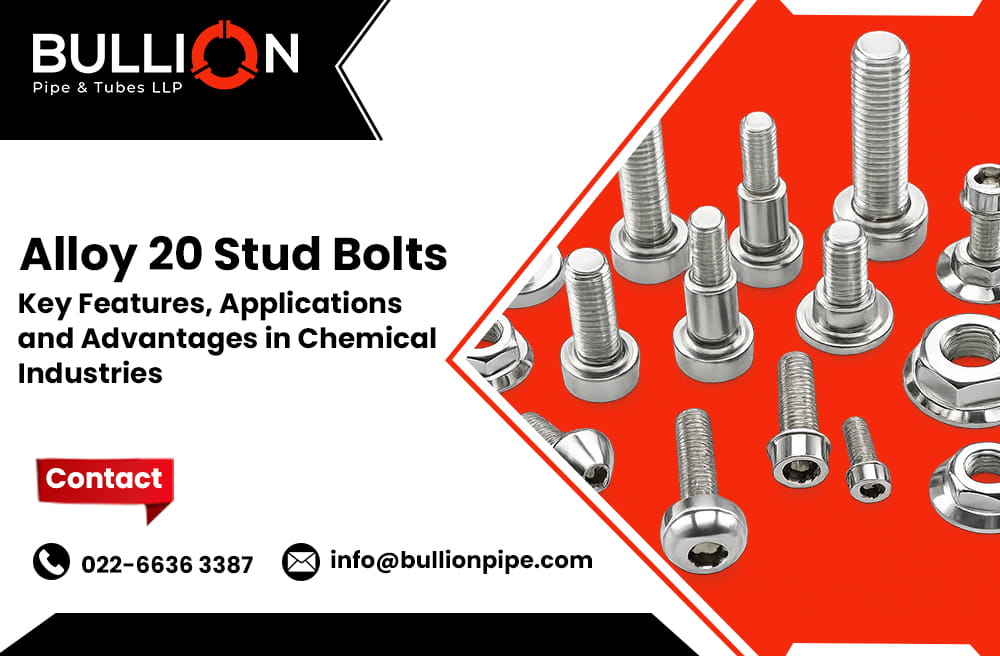
The choice of fasteners is an important consideration in industries that involve the use of equipment that is exposed to aggressive chemicals as this ensures safety, reliability and long service life. Alloy 20 stud bolts have now become a popular choice of chemical-processing environments due to the existence of numerous corrosion-resistant alloys available in the modern world. These fasteners are specifically designed to withstand acid corrosion and withstand the harsh industrial environment, enabling excellent performance in the most demanding applications.
To manufacturers, plant operators, and maintenance teams, the knowledge about the properties and benefits of alloy 20 fasteners can assist in assuring the integrity of piping systems, pressure vessels, and processing equipment. Firms such as Bullion Pipe use quality alloy 20 stud bolts which are designed to satisfy the high demands of chemical industries all over the world.
This guide discusses the main characteristics, uses and benefits of alloy 20 stud bolts and reasons as to why they are commonly used in chemical processing plants.
What Are Alloy 20 Stud Bolts?
Alloy 20 stud bolts are fasteners that are corrosion-resistant and made of Alloy 20, a nickel-iron-chromium alloy which includes copper and molybdenum. The alloy was designed to have an outstanding ability of withstanding sulfuric acid and other strong chemicals, which are often utilized in chemical processing.
A stud bolt is a threaded rod with threads on either end, and is commonly held by two nuts to hold flanges, valves and pumps etc. These bolts are required to resist corrosion, high temperatures, and mechanical stress in a chemical plant, yet be capable of supporting the structural integrity of the plant.
Due to these harsh environments, alloy 20 fasteners are commonly chosen in areas where the conventional stainless steel fasteners can break.
Composition and Properties of Alloy 20
Carpenter 20, also referred to as Alloy 20, is a balance between mechanical strength and corrosion resistance. It has a characteristic chemical formula of:
- Nickel
- Chromium
- Iron
- Copper
- Molybdenum
This composition enables the material to withstand different types of corrosion which include:
- Pitting corrosion
- Stress corrosion cracking
- Crevice corrosion
- Acid attack
Alloy 20 stud bolts are also good in terms of mechanical strength and stability over a broad temperature range and therefore can be trusted to critical industrial systems.
Important Characteristics of Alloy 20 Stud Bolts
1. Exceptional Corrosion Resistance
The fact that alloy 20 stud bolts resist sulfuric acid and other corrosive agents is one of the most crucial features of these types of bolts. This renders them suitable in chemical plants whereby exposure to acidic environments is frequent.
2. Stress Resistance to Corrosion Cracking
Alloy 20 fasteners are particularly created to withstand stress corrosion crack, which is prevalent in environments with high chloride. This property greatly enhances the reliability of the bolts in the chemical processing systems.
3. High Mechanical Strength
These rivets are very strong in tensile and enduring strength. Alloy 20 stud bolts also have a high degree of structural stability and performance even when subjected to high pressure or heavy mechanical loads.
4. Good Fabrication and Machinability
Alloy 20 has a relatively good machinability compared to many other high-nickel alloys. This enables manufacturers to manufacture high precision fasteners that suit the industry.
5. Superior Performance in tough conditions
The oxidation and corrosion resistance of the alloy make it very durable in the long term. This means that alloy 20 fasteners will need fewer replenishment, which will save on maintenance.
Alloy 20 Stud Bolts Used in Chemical Industries
Due to strength and corrosion resistance, alloy 20 stud bolts have many applications in the chemical industry.
1. Chemical Processing Plants
Sulfuric acid, phosphoric acid, and nitric acid are some of the corrosive chemicals that chemical plants deal with. These environments are usually fastened using alloy 20.
2. Petrochemical Industry
The petrochemical plants are usually in need of materials which are capable of resisting the corrosive chemicals and the heat. Alloy 20 stud bolts are applied in equipment like heat exchangers, pumps and pressure vessels.
3. Pharmaceutical Manufacturing
Pharmaceutical manufacturing sites need substances that are chemically stable and that can not be contaminated. Alloy 20 fasteners can be used in equipment that is associated with chemical synthesis and processing.
4. Food Processing Equipment
Alloy 20 stud bolts are effective in offering good corrosion resistance in food processing settings where handling of acidic substances is involved without compromising on hygiene and safety levels.
5. Pollution Control Systems
Corrosive gases and liquids are usually processed in environmental systems like scrubbers and waste treatment plants. These systems are composed of alloy 20 fasteners which work to guarantee the safety and durability of the systems.
Benefits of Alloy 20 Fasteners
1. Excellent Protection against acidic conditions
Alloy 20 fasteners are made to work well in the sulfuric acid environment unlike many stainless steel fasteners, which are suitable in the chemical plants.
2. Longer Service Life
Alloy 20 stud bolts are more durable than most of the conventional fasteners, due to their corrosion resistance, and mechanical strength. This saves maintenance and replacement expenses in the long-term.
3. Enhanced Safety and Reliability
Equipment failure in the chemical processing plants may cause expensive downtime and threats to safety. Alloy 20 fasteners offer a high level of performance which ensures the integrity of industrial systems.
4. Reduced Maintenance Costs
These fasteners are less prone to routine maintenance and replacement as they are corrosion resistant and cannot be readily attacked by chemicals and this enhances overall efficiency.
5. Versatile Industrial Applications
In chemical processing, pharmaceutical manufacturing, and many more, alloy 20 stud bolts can be utilized in a wide variety of industries where corrosion resistance is a critical factor.
The reason Alloy 20 Stud Bolts are favored in Chemical Industries
The industrial industry has chemical plants that work in environments that are the most aggressive. The equipment should be able to endure the continuous exposure to acids, chemicals, and high temperatures.
Alloy 20 stud bolts have been specifically made to withstand such conditions. They are an ideal solution in securing critical equipment like pipelines, flanges, valves, and reactors due to their combination of corrosion resistance, strength and durability.
The suppliers such as Bullion Pipe offer certified alloy 20 fasteners that are quality and safe and suitable in harsh industrial applications.
In the chemical industry, selecting the right fasteners is essential for maintaining safety, efficiency, and long-term reliability. Alloy 20 stud bolts offer exceptional corrosion resistance, strong mechanical properties, and durability in highly aggressive environments.
Their ability to withstand sulfuric acid, resist stress corrosion cracking, and maintain performance under pressure makes them one of the most trusted fastening solutions in chemical processing plants.
With the support of reliable suppliers such as Bullion Pipe, industries can ensure access to high-quality alloy 20 fasteners that meet the demanding requirements of modern chemical manufacturing.
To buy Alloy 20 Stud Bolts in India of high-quality and at an affordable Alloy 20 Stud Bolts Price in India please ‘Get in Touch’ with Bullion Pipe now
FAQ
1. What are alloy 20 stud bolts used for?
Alloy 20 stud bolts are mainly used in chemical processing plants, petrochemical facilities, pharmaceutical equipment, and pollution control systems where corrosion resistance is essential.
2. Why are alloy 20 fasteners suitable for chemical industries?
Alloy 20 fasteners offer excellent resistance to sulfuric acid, pitting corrosion, and stress corrosion cracking, making them ideal for harsh chemical environments.
3. What is the main advantage of alloy 20 stud bolts over stainless steel bolts?
The main advantage is superior corrosion resistance, especially against sulfuric acid and aggressive chemicals that can damage standard stainless steel fasteners.
4. Are alloy 20 stud bolts resistant to high temperatures?
Yes, alloy 20 stud bolts maintain good mechanical strength and corrosion resistance across a wide temperature range, making them suitable for industrial processing equipment.
5. Where can industries buy high-quality alloy 20 fasteners?
Industries can source certified alloy 20 fasteners from trusted suppliers such as Bullion Pipe that specialize in corrosion-resistant piping and fastening solutions.