
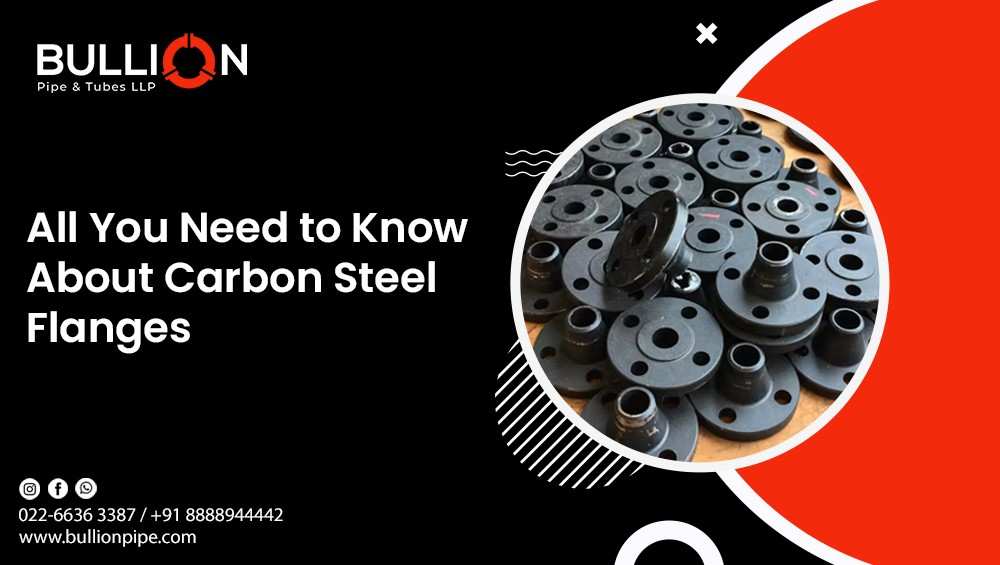
In industrial piping systems, flanges are one of the most critical components. They connect pipes, valves, pumps, and other equipment to form a secure, leak-proof network. Among all flange materials available in the market, carbon steel flanges remain the most widely used — and for very good reason.
Whether you are working on an oil and gas pipeline in Saudi Arabia, a petrochemical plant in UAE, or a power generation facility anywhere in the world, carbon steel flanges offer the perfect combination of strength, durability, and cost-effectiveness.
In this complete guide, we cover everything you need to know about carbon steel flanges — including types, material grades, pressure ratings, applications, and how to choose the right flange for your project.
1. What Are Carbon Steel Flanges?
Carbon steel flanges are mechanical components used to connect pipes, valves, and equipment in a piping system. They are made from carbon steel — a metal alloy that contains iron and carbon — which gives them exceptional strength, hardness, and resistance to high pressure and temperature.
The carbon content in the steel typically ranges from 0.05% to 2.0%, depending on the grade. Higher carbon content increases hardness and tensile strength, while lower carbon content improves weldability and ductility.
Carbon steel flanges are manufactured to international standards including ASME B16.5, ASME B16.47, and API 6A, ensuring consistent quality and compatibility across global industrial projects.
2. Types of Carbon Steel Flanges
Carbon steel flanges are available in 6 main types. Each type is designed for specific pressure conditions, temperature ranges, and installation requirements. Here is a complete overview:
A. Weld Neck Flanges
Weld neck flanges are the most commonly used type in high-pressure applications. They have a long tapered hub that provides excellent stress distribution and minimises turbulence in fluid flow. The flange is butt-welded to the pipe, creating a strong, reliable joint.
- Best for: High-pressure, high-temperature pipelines
- Industries: Oil & gas, petrochemical, power generation
- Pressure rating: Class 150 to Class 2500
- Standard: ASME B16.5
B. Slip-On Flanges
Slip-on flanges slide over the pipe and are then welded on both the inside and outside. They are easier to align than weld neck flanges and are more cost-effective, making them a popular choice for low to medium-pressure applications.
- Best for: Low to medium-pressure systems
- Industries: Water treatment, HVAC, general industrial piping
- Pressure rating: Class 150 to Class 600
- Advantage: Easy installation and alignment
C. Blind Flanges
Blind flanges are solid discs with no centre bore. Their primary purpose is to seal or blank off the end of a pipe, vessel, or valve. They are also used during pressure testing and system maintenance to isolate sections of a pipeline.
- Best for: Pipe termination, pressure testing, system isolation
- Industries: Oil & gas, chemical, water treatment
- Pressure rating: Class 150 to Class 2500
- Advantage: Can be removed easily for future access
D. Threaded Flanges
Threaded flanges have internal threads that allow them to be screwed directly onto the pipe without welding. This makes them ideal for applications where welding is not practical or permitted — such as in explosive or flammable environments.
- Best for: Applications where welding is not feasible
- Industries: Low-pressure gas lines, fire protection systems
- Pressure rating: Class 150 to Class 2500
- Advantage: No welding required — faster installation
E. Lap Joint Flanges
Lap joint flanges consist of two parts — a stub end and a backing flange. The stub end is welded to the pipe, while the backing flange is free to rotate around it. This design makes alignment easy and allows for quick disassembly, which is valuable in systems requiring frequent maintenance.
- Best for: Systems requiring frequent dismantling and inspection
- Industries: Chemical processing, pharmaceutical, food & beverage
- Pressure rating: Class 150 to Class 600
- Advantage: Easy alignment and bolt-hole matching
F. Socket Weld Flanges
Socket weld flanges are designed for small-bore, high-pressure piping. The pipe is inserted into the socket and a single fillet weld is applied on the outside. They provide excellent strength and a smooth bore for fluid flow.
- Best for: Small diameter, high-pressure piping
- Industries: Hydraulic systems, steam lines, chemical plants
- Pressure rating: Class 150 to Class 2500
- Note: Avoid in corrosive or crevice-sensitive environments
| Flange Type | Best Application | Pressure Range | Welding Required |
| Weld Neck | High-pressure oil & gas pipelines | Class 150–2500 | Yes |
| Slip-On | Low-medium pressure general piping | Class 150–600 | Yes |
| Blind | Pipe termination & pressure testing | Class 150–2500 | No |
| Threaded | Non-welding environments | Class 150–2500 | No |
| Lap Joint | Frequent dismantling systems | Class 150–600 | Yes (stub end) |
| Socket Weld | Small bore high-pressure lines | Class 150–2500 | Yes |
3. Carbon Steel Flange Material Grades
The material grade of a carbon steel flange determines its mechanical properties, temperature range, and suitability for different applications. Here are the most commonly used grades:
| Grade | Standard | Temp Range | Best Application |
| A105 | ASTM A105 | -20°F to 800°F | General purpose flanges, valves, fittings |
| A182 F11 | ASTM A182 | Up to 1100°F | High-temperature steam & power generation |
| A182 F22 | ASTM A182 | Up to 1200°F | Hydroprocessing units in refineries |
| A182 F5 | ASTM A182 | Up to 1200°F | High-temperature corrosive environments |
| A182 F91 | ASTM A182 | Up to 1300°F | Ultra-supercritical power plants |
| A694 F52/F65 | ASTM A694 | Pipeline service | High-yield pipeline transmission systems |
4. Key Advantages of Carbon Steel Flanges
Carbon steel flanges are the preferred choice across industries for several important reasons:
- Exceptional Strength & Durability: High carbon content gives these flanges superior tensile strength and hardness, making them capable of withstanding extreme pressure and temperature conditions.
Carbon steel flanges can handle pressures from Class 150 (285 PSI) all the way up to Class 2500 (6,170 PSI), covering virtually all industrial applications.
- Cost-Effectiveness: Compared to stainless steel, alloy steel, or exotic alloys like Inconel and Hastelloy, carbon steel flanges offer excellent mechanical performance at a significantly lower cost.
This makes them the go-to choice for large-scale projects where hundreds or thousands of flanges are required.
- Wide Availability & Easy Fabrication: Carbon steel is one of the most widely available materials globally. It is easy to machine, weld, and thread — which reduces fabrication time and installation costs.
- Versatility Across Pressure Classes: Available in all standard pressure classes from 150 to 2500, carbon steel flanges can be used in virtually any industrial piping application.
- Coating & Treatment Options: Carbon steel flanges can be coated with galvanizing, epoxy, or PTFE to enhance corrosion resistance, extending their service life in harsh environments.
5. Industrial Applications of Carbon Steel Flanges
Carbon steel flanges are used across a wide range of industries worldwide. Here are the most significant applications:
Oil & Gas Industry
This is the largest application sector for carbon steel flanges. They are used in upstream, midstream, and downstream operations — connecting pipelines, wellheads, manifolds, separators, and processing equipment. In the Gulf region (UAE, Saudi Arabia, Qatar, Oman), carbon steel flanges are extensively used in ADNOC, Saudi Aramco, and QatarEnergy projects.
Petrochemical & Chemical Industry
Petrochemical plants use carbon steel flanges in reactors, heat exchangers, distillation columns, and pipeline networks. For processes involving corrosive chemicals, flanges are coated or lined with appropriate protective materials.
Power Generation
In thermal power plants, carbon steel flanges are used in steam turbines, boilers, condensers, and feedwater systems. High-temperature grades like ASTM A182 F11 and F22 are specifically designed for power generation applications.
Water & Wastewater Treatment
Municipal water treatment plants and industrial wastewater facilities use carbon steel flanges for connecting large-diameter pipelines, valves, and pumping equipment. Their durability and cost-effectiveness make them ideal for this sector.
Construction & Infrastructure
Carbon steel flanges are used in HVAC systems, fire protection pipelines, structural applications, and general plumbing in commercial and industrial buildings.
| Industry | Key Applications | Common Grade |
| Oil & Gas | Pipelines, wellheads, manifolds, separators | ASTM A105, A182 F11 |
| Petrochemical | Reactors, heat exchangers, process pipelines | ASTM A105, A182 F22 |
| Power Generation | Steam systems, boilers, turbines | ASTM A182 F11, F22, F91 |
| Water Treatment | Large-diameter pipelines, pump connections | ASTM A105 |
| Construction | HVAC, fire protection, general plumbing | ASTM A105 |
| Mining | Slurry pipelines, process equipment | ASTM A105, A694 |
6. How to Choose the Right Carbon Steel Flange
Selecting the correct carbon steel flange for your project requires careful consideration of several factors. Here is a simple step-by-step guide:
- Identify the Operating Pressure: Check the maximum working pressure of your piping system. Select the appropriate pressure class — Class 150, 300, 600, 900, 1500, or 2500 — accordingly.
- Check the Operating Temperature: For temperatures below 800°F, ASTM A105 is sufficient. For higher temperatures, specify A182 F11, F22, or F91 depending on the exact temperature range.
- Select the Flange Type: Choose based on your installation requirements — weld neck for high-pressure, slip-on for easy installation, blind for termination, threaded for non-welding applications.
- Verify the Pipe Size: Confirm the nominal pipe size (NPS) and match it to the correct flange size. Carbon steel flanges are available from 1/2 inch to 60 inches.
- Check the Facing Type: Common facing types include raised face (RF), flat face (FF), and ring type joint (RTJ). Specify the correct facing for your gasket and sealing requirements.
- Confirm Standards & Certifications: Ensure the flanges meet ASME B16.5, ASME B16.47, or API 6A standards as required by your project specifications.
7. Maintenance & Care Tips
Proper maintenance of carbon steel flanges ensures long service life and prevents costly failures. Follow these best practices:
- Regular Inspection: Inspect flanges periodically for signs of corrosion, leakage, or mechanical damage. Early detection prevents catastrophic failures.
- Proper Bolt Torquing: Always tighten flange bolts to the specified torque values using a calibrated torque wrench. Uneven tightening can cause gasket failure and leaks.
- Gasket Replacement: Replace gaskets during every maintenance shutdown. Never reuse old gaskets as they lose their sealing ability over time.
- Protective Coatings: Apply appropriate coatings — epoxy, zinc, or PTFE — in corrosive environments to extend flange life.
- Correct Installation: Ensure flanges are perfectly aligned before tightening. Misalignment creates stress concentrations that can lead to cracks or leaks.
- Documentation: Maintain records of flange installation, inspection dates, and maintenance history for traceability and safety compliance.
8. Frequently Asked Questions (FAQs)
Q: What is the most common grade of carbon steel flange?
ASTM A105 is the most commonly used grade for carbon steel flanges in general industrial applications. It is suitable for temperatures ranging from -20°F to 800°F and covers most standard piping requirements.
Q: What is the difference between ASTM A105 and ASTM A182?
ASTM A105 is used for general-purpose carbon steel flanges at temperatures up to 800°F. ASTM A182 covers alloy and stainless steel flanges designed for higher temperatures — grades F11 and F22 are commonly used in power generation and petrochemical applications above 800°F.
Q: Can carbon steel flanges be used in corrosive environments?
Standard carbon steel flanges are not highly resistant to corrosion. However, they can be coated with protective finishes such as epoxy, galvanizing, or PTFE to improve corrosion resistance. For highly corrosive environments, stainless steel or alloy flanges are recommended.
Q: What pressure classes are available for carbon steel flanges?
Carbon steel flanges are available in pressure classes 150, 300, 600, 900, 1500, and 2500 as per ASME B16.5 standard. The pressure class determines the maximum allowable working pressure at a given temperature.
Q: How long do carbon steel flanges last?
With proper installation, regular maintenance, and appropriate protective coatings, carbon steel flanges can last 20 to 30 years or more in standard industrial environments. Service life depends on operating conditions, fluid type, and maintenance practices.
Q: Do you supply carbon steel flanges to international markets?
Yes, Bullion Pipe & Tubes LLP supplies certified carbon steel flanges to UAE, Saudi Arabia, Qatar, Oman, Kuwait, South Africa, Nigeria, USA, UK, Canada, Singapore, and 20+ other countries worldwide. We offer complete documentation including mill test certificates, third-party inspection reports, and ASME/ASTM compliance certificates.
Conclusion
Carbon steel flanges remain the backbone of industrial piping systems across the globe. Their exceptional combination of strength, versatility, and cost-effectiveness makes them the preferred choice for oil & gas, petrochemical, power generation, and construction industries.
Whether you need standard ASTM A105 flanges for general applications or high-temperature A182 grades for demanding environments, choosing the right type and grade is critical for the safety and reliability of your piping system.
At Bullion Pipe & Tubes LLP, we manufacture and supply a comprehensive range of carbon steel flanges in all types, grades, sizes, and pressure classes. Our flanges are fully certified to ASME, ASTM, and API standards and are trusted by engineering firms and procurement teams across UAE, Saudi Arabia, Qatar, and 20+ countries worldwide.