
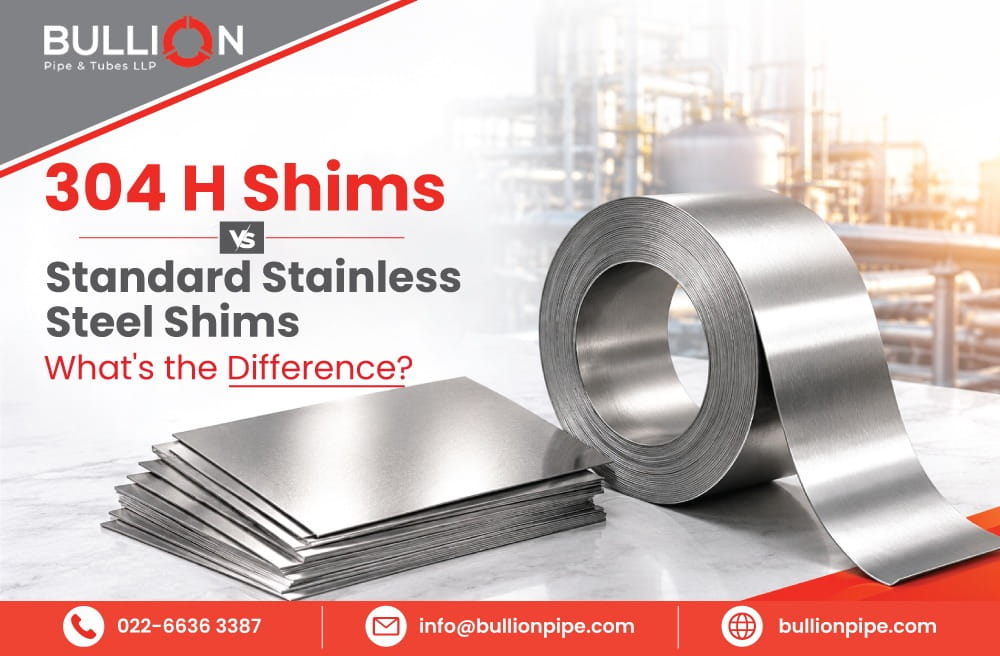
In industrial engineering, even a small component can make a significant difference to the performance, safety, and reliability of an assembly. Shims are a perfect example. Although they are thin pieces of metal, they play an important role in adjusting clearances, aligning machinery, compensating for dimensional variations, and maintaining precise spacing between components.
However, not all shims are designed for the same operating conditions. When engineers and procurement professionals compare stainless steel 304H shims with standard stainless steel shims, the key differences involve carbon content, high-temperature performance, mechanical properties, and suitability for demanding industrial applications.
At Bullion Pipe and Tubes LLP, understanding these differences helps buyers make informed material selections based on their operating environment, engineering specifications, and long-term performance requirements.
What Are Stainless Steel Shims?
Stainless steel shims are thin metal sheets or precision-cut components used to fill small gaps, adjust component heights, and achieve accurate alignment in mechanical and industrial assemblies.
Their applications range from machinery installation and automotive components to chemical processing equipment, fabrication projects, and industrial maintenance.
Depending on the application, stainless steel shims may be manufactured from grades such as 304, 304L, 304H, and other stainless steel alloys. Each grade offers different characteristics that influence its performance under specific conditions.
For instance, standard stainless steel 304 shims are widely used for general-purpose applications because of their corrosion resistance, formability, and versatility. By comparison, stainless steel 304H shims are specifically associated with applications where elevated-temperature strength is an important consideration.
The right choice depends on more than the thickness of the shim. Temperature, loading conditions, exposure to corrosive substances, and dimensional requirements must also be evaluated.
What Are Stainless Steel 304H Shims?
Stainless steel 304H shims are manufactured from Type 304H austenitic stainless steel, a grade with a higher carbon content than standard Type 304 and Type 304L.
The higher carbon content helps improve strength retention at elevated temperatures, making 304H particularly useful in certain high-temperature service environments.
These shims can be considered for industrial assemblies where precision spacing and material performance under heat are important. However, the suitability of a particular shim depends on its thickness, manufacturing process, design requirements, and the applicable material specification.
Industries such as petrochemicals, thermal processing, power generation, and industrial equipment manufacturing may require high-temperature-capable stainless steel components, including shims where appropriate.
At Bullion Pipe and Tubes LLP, buyers should evaluate the specified grade and required dimensions before selecting stainless steel 304H shims for a project.
304H Shims vs Standard Stainless Steel Shims: Key Differences
The most important distinction is that 304H is a specific stainless steel grade, whereas standard stainless steel shims can refer to products manufactured from several different grades. The comparison below uses Type 304 as the reference for standard stainless steel shims.
| Comparison factor | Stainless steel 304H shims | Standard stainless steel 304 shims |
| Carbon content | Higher, typically 0.04–0.10% | Lower, typically up to 0.08% |
| High-temperature performance | Better suited to certain elevated-temperature applications | Commonly selected for general-purpose service |
| Elevated-temperature strength | Higher carbon content supports strength retention at elevated temperatures | May be less suitable where the design specifically requires 304H |
| Corrosion resistance | Generally good in many environments | Generally good in many environments |
| Fabrication | Depends on thickness and processing requirements | Widely used for forming and fabrication |
| Typical applications | Specified high-temperature industrial assemblies | General engineering, machinery alignment, and fabrication |
| Material selection | Appropriate when the design specifies 304H or its properties | Appropriate when standard 304 meets the application requirements |
Note: These are general grade-level comparisons, not guaranteed performance values for every finished shim.
Carbon Content and Material Properties
Carbon content is one of the primary differences between these grades.
Type 304H generally contains 0.04–0.10% carbon, while standard Type 304 permits up to 0.08%. Type 304L, another commonly used stainless steel grade, has a maximum carbon content of 0.03%.
The higher carbon range in 304H is intended to support high-temperature strength requirements. However, it does not automatically make every 304H shim stronger under every loading condition.
For precision engineering applications, buyers should review the relevant material standard, product form, thickness, and mechanical property requirements before finalising their choice.
Performance Under Elevated Temperatures
Temperature is often the deciding factor when selecting between 304H and standard stainless steel shims.
In applications involving sustained elevated temperatures, material strength and resistance to deformation can become critical. Stainless steel 304H is commonly specified for certain high-temperature equipment because its composition is designed to support elevated-temperature service.
Standard 304 stainless steel remains suitable for many everyday industrial applications, including alignment and spacing in equipment operating under moderate conditions.
However, a shim exposed to substantial heat and compressive loading may require a more detailed engineering assessment. Temperature alone does not determine suitability; stress, exposure duration, oxidation, thermal cycling, and the design’s allowable deformation must also be considered.
Corrosion Resistance and Industrial Durability
Both 304H and standard 304 belong to the austenitic stainless steel family and generally provide good corrosion resistance in many atmospheric and industrial environments.
Nevertheless, neither grade is universally resistant to all chemicals, acids, chlorides, or aggressive processing conditions.
The higher carbon content of 304H can increase susceptibility to sensitisation during certain thermal exposures compared with low-carbon grades such as 304L. This is particularly relevant when corrosion resistance after welding or prolonged heating is important.
Therefore, buyers should assess the complete service environment rather than assuming that the higher-temperature grade always offers superior corrosion resistance.
Applications: Where Does Each Grade Work Best?
Choosing between stainless steel 304H shims and standard stainless steel shims becomes easier when the intended application is clearly defined.
Stainless steel 304H shims may be considered for:
- Specified high-temperature industrial assemblies.
- Certain thermal processing and power-generation equipment.
- Equipment where elevated-temperature strength retention is an important design consideration.
- Industrial applications requiring a material grade explicitly specified as 304H.
Standard stainless steel 304 shims may be considered for:
- Machinery levelling and alignment.
- General fabrication and assembly work.
- Equipment spacers and dimensional adjustments.
- Industrial maintenance applications requiring corrosion resistance and general-purpose performance.
In either case, the selected shim must meet the project’s dimensional tolerances, loading requirements, and relevant material specifications.
How to Choose the Right Stainless Steel Shims
For engineers and procurement teams, the best purchasing decision starts with the application rather than the material price alone.
First, determine the maximum operating temperature and the mechanical load the shim must withstand. Next, establish the required thickness, width, length, tolerance, and surface finish.
The next step is to verify the material grade. If the engineering drawing specifies 304H, substituting standard 304 without technical approval may compromise compliance with the design requirements.
Buyers should also consider exposure to moisture, chemicals, welding-related heat, and repeated thermal cycles. Where necessary, an engineering team should review the material specification and applicable code requirements.
Finally, source stainless steel shims from a supplier that can confirm the supplied grade, dimensions, and relevant material documentation. This helps reduce procurement errors and supports consistent quality across industrial projects.
For businesses sourcing precision stainless steel components, Bullion Pipe and Tubes LLP can be approached to discuss material requirements, dimensions, and application-specific specifications.
The difference between stainless steel 304H shims and standard stainless steel shims lies primarily in their intended service conditions and material composition.
Type 304H offers a higher carbon range designed to support strength at elevated temperatures, while standard Type 304 remains a versatile choice for general industrial applications. Neither grade is universally superior; the right option depends on temperature, mechanical loading, corrosion exposure, and engineering specifications.
By understanding these distinctions, industrial buyers can make more informed material decisions, improve assembly reliability, and avoid selecting a grade that does not meet the application’s requirements.
Bullion Pipe and Tubes LLP encourages buyers to evaluate material specifications carefully and choose stainless steel shims according to their actual operating needs. ]
So, to buy 304H Shims or Standard Stainless Steel Shims of Premium Quality at an affordable 304H Shims and Standard Stainless Steel Shims Price in India visit us at Bullion Pipe and Tubes LLP today.
1. What are stainless steel 304H shims used for?
Stainless steel 304H shims are used for precision spacing, alignment, and dimensional adjustment in industrial assemblies where the specified material must support elevated-temperature service. Their suitability depends on operating conditions and design requirements.
2. What is the difference between 304H shims and standard stainless steel shims?
The main difference is the material grade. Type 304H has a higher specified carbon range than standard Type 304 and is designed to support elevated-temperature strength requirements. Standard 304 shims are widely used for general-purpose industrial applications.
3. Are stainless steel 304H shims suitable for high-temperature applications?
Yes, stainless steel 304H shims may be suitable for certain high-temperature applications. However, suitability depends on the actual operating temperature, applied stress, exposure duration, and relevant engineering standards.
4. Do stainless steel 304H shims offer better corrosion resistance than standard 304 shims?
Not necessarily. Both grades generally offer good corrosion resistance in many environments. Type 304H’s higher carbon content can increase sensitisation concerns under certain thermal conditions, so the operating environment and fabrication history must be considered.
5. How can buyers select the right stainless steel shims from Bullion Pipe?
Buyers should specify the required grade, thickness, dimensions, tolerances, operating temperature, loading conditions, and corrosion exposure. They should also request appropriate material documentation and confirm that the supplied product meets the applicable engineering specification.