
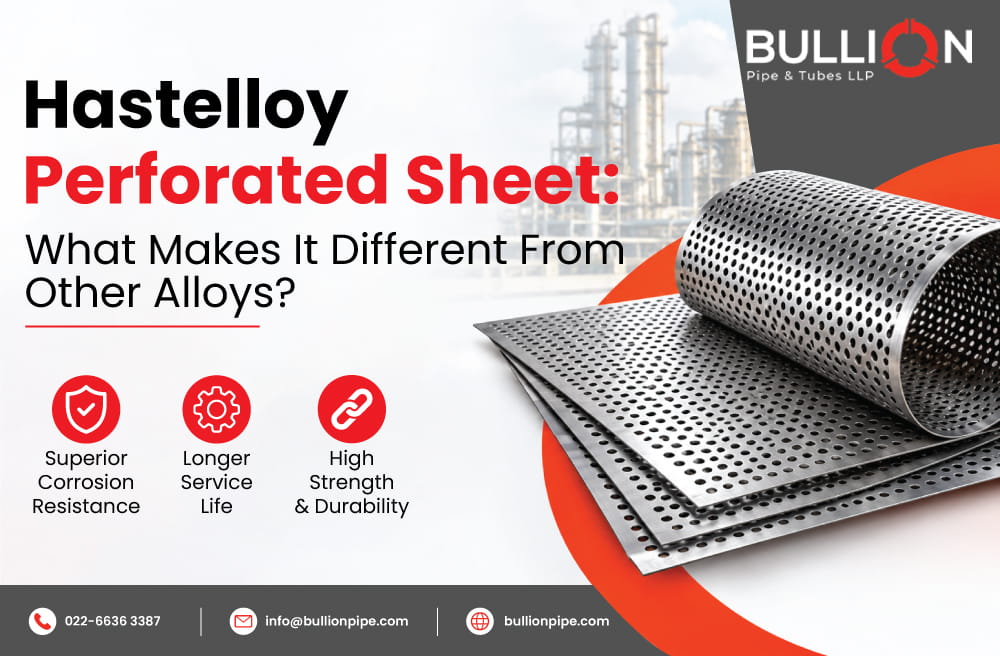
In industries where corrosion, high temperatures, and aggressive chemicals can challenge the reliability of conventional materials, selecting the right metal becomes more than a purchasing decision. It becomes a question of long-term performance, operational safety, and maintenance costs. This is where a Hastelloy perforated sheet stands apart from many conventional alloy sheets.
For chemical processing plants, pollution control systems, filtration equipment, and demanding industrial applications, Hastelloy offers a combination of corrosion resistance, mechanical reliability, and application flexibility. When this nickel-based alloy is manufactured with precision perforations, it becomes suitable for applications that require both material durability and controlled flow of liquids, gases, or particles.
At Bullion Pipe and Tubes LLP, understanding these material differences helps industrial buyers make informed decisions based on operating conditions rather than price alone.
What Is a Hastelloy Perforated Sheet?
A Hastelloy perforated sheet is a sheet manufactured from a corrosion-resistant nickel-based alloy and processed with regularly arranged holes. These perforations may be round, square, slotted, or designed according to specific engineering requirements.
The sheet combines the properties of Hastelloy with the functional advantages of a perforated metal product. Depending on the grade, it can provide resistance to aggressive chemicals, oxidation, and demanding industrial environments.
Different Hastelloy grades offer different performance characteristics. Hastelloy C-276, for example, is widely recognised for its resistance to a broad range of corrosive environments, while Hastelloy C-22 offers strong resistance to several oxidising and reducing media. The appropriate grade depends on the chemicals, temperature, concentration, and operating conditions involved.
Simply put, a Hastelloy perforated sheet is not just a metal sheet with holes. It is an engineered material solution for applications where corrosion resistance and controlled passage of fluids or gases must work together.
What Makes Hastelloy Perforated Sheet Different From Other Alloys?
The primary difference lies in its corrosion resistance, alloy composition, and suitability for demanding chemical environments. However, its advantages become clearer when compared with other commonly used materials.
1. Superior Corrosion Resistance in Demanding Environments
Stainless steel is widely used in industrial fabrication because of its strength, availability, and general corrosion resistance. However, certain aggressive acids, chloride-containing environments, and mixed chemical solutions can cause pitting, crevice corrosion, or other forms of material degradation.
A Hastelloy perforated sheet, particularly one manufactured from a suitable C-276 or C-22 grade, can offer better resistance in many such environments.
For chemical processing equipment, scrubbers, filtration assemblies, and pollution control systems, this resistance can help extend component service life. Nevertheless, actual performance depends on the precise alloy grade and operating conditions.
2. Better Suitability for High-Temperature Applications
Industrial equipment frequently operates under elevated temperatures, where oxidation, chemical attack, and mechanical stress can affect material performance.
Selected Hastelloy grades are designed to perform in demanding thermal and chemical environments. This makes them potential candidates for specialised process equipment, heat-treatment systems, and certain industrial filtration applications.
However, not every Hastelloy grade is suitable for every high-temperature requirement. Engineers must evaluate temperature limits, mechanical loading, chemical exposure, and the effects of perforation geometry before selecting a material.
3. Different Alloy Composition for Specialised Performance
Hastelloy alloys generally contain nickel as their principal constituent, with chromium, molybdenum, and other elements varying by grade.
These alloying elements influence corrosion resistance, oxidation resistance, and performance in specific chemical environments.
By comparison, stainless steel typically relies on chromium for its protective passive layer, while carbon steel primarily offers an economical solution for applications where corrosion can be adequately controlled.
This distinction explains why Hastelloy is often considered for specialised environments where standard alloys may require more frequent replacement or additional protective measures.
4. Functional Advantages of Perforated Construction
The perforated design adds another layer of functionality. Depending on hole size, pattern, sheet thickness, and open-area percentage, a Hastelloy perforated sheet can facilitate fluid flow, gas circulation, screening, drainage, and particle separation.
For example, a chemical processing plant may require a corrosion-resistant screen that allows liquid to pass through while retaining larger particles. A suitable Hastelloy perforated sheet can help meet both requirements.
The final performance depends on the perforation pattern, structural support, pressure differential, and the material grade selected.
5. Potential for Lower Lifecycle Costs
Hastelloy generally carries a higher initial material cost than conventional stainless steel or carbon steel. However, the purchase price alone does not represent the total cost of ownership.
Where corrosion causes frequent shutdowns, maintenance work, component replacement, or production losses, a more corrosion-resistant alloy may offer better long-term value.
For industrial buyers, the objective should be to compare the expected service life, maintenance requirements, fabrication costs, and replacement frequency of each material option.
Hastelloy is not automatically the most economical choice for every application. Its value becomes clearer when the operating environment genuinely requires its specialised properties.
Hastelloy Perforated Sheet vs Stainless Steel and Other Alloys
The following comparison provides a practical starting point for material selection.
| Material | Key Properties | Corrosion Resistance | Common Industrial Applications | Key Consideration |
| Hastelloy Perforated Sheet | Nickel-based alloy with excellent resistance to selected aggressive chemical environments | Excellent in many demanding environments, depending on grade | Chemical processing, filtration, scrubbers, and industrial separation systems | Higher initial cost; grade selection is critical |
| Stainless Steel Perforated Sheet | Good strength, durability, and general corrosion resistance | Good to excellent, depending on grade | Food processing, architectural screens, filtration, and general industrial equipment | Some grades may be vulnerable to pitting and crevice corrosion |
| Carbon Steel Perforated Sheet | High strength and economical fabrication | Generally limited without protective coatings or corrosion control | Structural screens, machinery guards, and general-purpose applications | May corrode rapidly in aggressive environments |
| Inconel Perforated Sheet | Nickel-based alloy designed for demanding thermal and mechanical conditions | Varies by grade; selected grades offer excellent corrosion resistance | Aerospace, heat-treatment equipment, and high-temperature industrial systems | Often selected for specific high-temperature or high-strength requirements |
| Monel Perforated Sheet | Nickel-copper alloy with good resistance in selected marine and chemical environments | Excellent in certain seawater and reducing environments | Marine equipment, chemical processing, and specialised industrial components | Not suitable for every oxidising chemical environment |
The right choice depends on the service environment. Hastelloy may be preferred for particular chemical processing applications, while stainless steel, carbon steel, Inconel, or Monel may be more suitable for other operating requirements.
Where Is Hastelloy Perforated Sheet Used?
The applications of Hastelloy perforated sheet depend on the grade, sheet dimensions, perforation design, and required mechanical performance.
Common potential applications include:
- Chemical processing: Screens, internals, and specialised components exposed to corrosive process media.
- Filtration systems: Components that require corrosion resistance alongside controlled flow and particle separation.
- Pollution control: Selected scrubber and gas-treatment components exposed to aggressive chemicals.
- Pharmaceutical and specialty chemical industries: Equipment components where material compatibility and process conditions are carefully controlled.
- Industrial separation equipment: Perforated elements used for screening, drainage, or fluid distribution.
- Power and process industries: Specialised components operating in chemically or thermally demanding environments.
Before specifying a Hastelloy perforated sheet, buyers should confirm the required grade, thickness, hole diameter, pitch, open area, dimensions, and fabrication tolerances.
How to Choose the Right Hastelloy Perforated Sheet
Selecting the right product begins with understanding the application rather than choosing a material based on its name alone.
First, identify the chemicals the sheet will contact, including their concentration and temperature. Next, determine whether the application involves pressure, abrasion, vibration, or structural loading.
The required hole size and open-area percentage should also be considered because perforations affect flow characteristics and the sheet’s remaining load-bearing section. Fabrication methods, welding requirements, surface finish, and applicable material standards should be reviewed before procurement.
Buyers should request material test certificates and verify the specified alloy grade, product dimensions, and relevant manufacturing requirements. Where necessary, corrosion testing or engineering consultation can help confirm suitability.
For industrial procurement, working with a supplier that understands alloy specifications and application requirements can simplify the selection process.
Why Consider Bullion Pipe and Tubes LLP?
For businesses sourcing specialised alloy products, reliable material identification and specification clarity are essential. Bullion Pipe and Tubes LLP can be approached for enquiries concerning Hastelloy and other industrial alloy products, with requirements clearly defined before an order is finalised.
Buyers should communicate their intended application, preferred Hastelloy grade, dimensions, thickness, perforation pattern, and applicable standards to obtain an accurate quotation and confirm product availability.
A well-defined procurement process helps reduce specification mismatches and supports more reliable industrial operations.
A Hastelloy perforated sheet differs from conventional alloy sheets because it combines the functional benefits of perforated metal with the corrosion-resistant properties of selected nickel-based alloys. Its suitability for aggressive chemical environments, specialised filtration, and demanding process applications makes it an important option for industries that require more than general-purpose metal performance.
Nevertheless, the best material is always the one that matches the actual service conditions. By evaluating corrosion resistance, temperature, mechanical loading, perforation design, and lifecycle costs, industrial buyers can make better-informed decisions.
For companies evaluating corrosion-resistant perforated metal products, Bullion Pipe and Tubes LLP can be a starting point for discussing product specifications and sourcing requirements.
So, ‘Get in Touch’ with us now to Buy Hastelloy Perforated Sheet of Premium Quality at an affordable Hastelloy Perforated Sheet Price in India
1. What is a Hastelloy perforated sheet used for?
A Hastelloy perforated sheet is used in selected chemical processing, filtration, gas-treatment, screening, and industrial separation applications where corrosion resistance and controlled flow are important. Its suitability depends on the alloy grade and operating conditions.
2. How is Hastelloy perforated sheet different from stainless steel perforated sheet?
Hastelloy perforated sheet can offer better resistance to certain aggressive chemicals and corrosive environments than many stainless steel grades. Stainless steel may be more economical and entirely adequate for less demanding applications. The correct comparison depends on the specific grades and process conditions.
3. Which Hastelloy grade is best for a perforated sheet?
Hastelloy C-276 and C-22 are commonly considered for demanding corrosion-resistant applications, but neither is universally best. Chemical composition, temperature, concentration, and operating conditions should determine the grade selection.
4. Is Hastelloy perforated sheet suitable for high-temperature applications?
Selected Hastelloy grades can perform in certain high-temperature environments. However, maximum operating temperature and suitability depend on the grade, chemical exposure, mechanical loading, and design requirements. Technical evaluation is recommended before selection.
5. How can buyers source a Hastelloy perforated sheet from Bullion Pipe and Tubes LLP?
Buyers can contact Bullion Pipe and Tubes LLP with their required Hastelloy grade, sheet thickness, dimensions, hole diameter, perforation pattern, quantity, and applicable standards. Availability, specifications, documentation, and pricing should be confirmed directly with the supplier before ordering.