
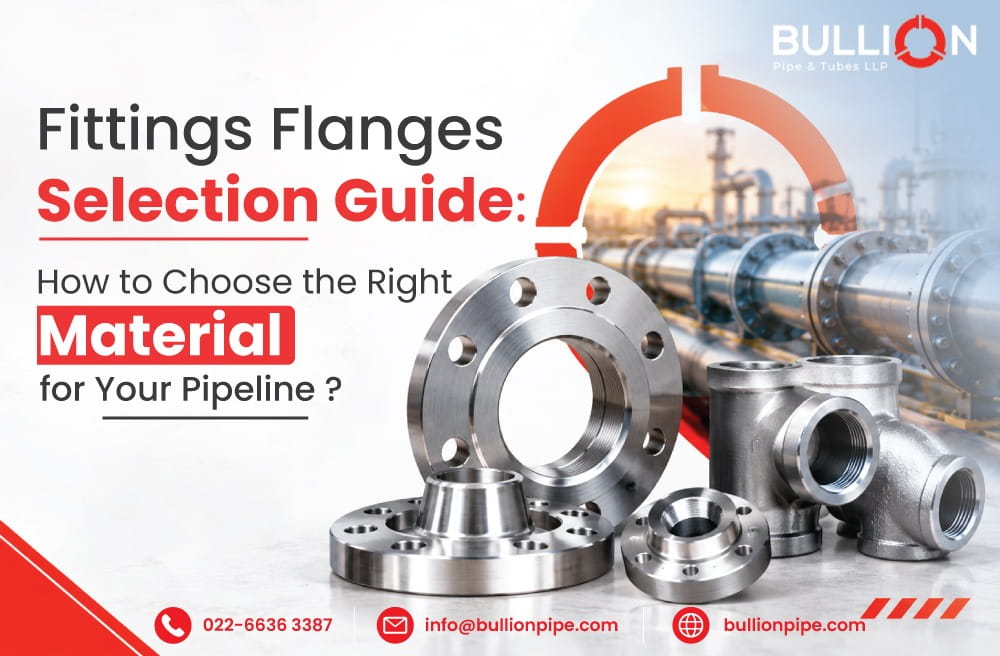
Choosing the right components for an industrial pipeline is essential for maintaining safety, durability, leak prevention, and long-term operating efficiency. Among the most important components are fittings and flanges, which provide secure connections between pipes, valves, pumps, equipment, and other piping components. However, selecting a flange is not simply a matter of choosing a size that fits the pipe. Material compatibility, pressure, temperature, corrosion resistance, application conditions, and applicable standards must all be considered.
This guide explains what fittings flanges are, why material selection matters, where they are used, who should supply them, when different materials are appropriate, and how to choose the right option for your pipeline.
What Are Fittings Flanges?
Fittings flanges are mechanical components used to create detachable connections between sections of a piping system or between pipes and equipment. A flange generally has a flat or specially designed face, bolt holes, and a central bore through which the fluid passes. When two compatible flanges are aligned, bolts and a gasket can be used to create a controlled, sealed joint.
Unlike permanently welded connections, flanged connections can be dismantled for inspection, maintenance, cleaning, replacement, or equipment servicing. This makes them particularly useful in industrial installations where regular maintenance is required.
Flanges can be manufactured from different materials, including stainless steel, carbon steel, alloy steel, nickel alloys, and other engineering materials.
Why Is Flange Material Selection Important?
The material of a flange directly affects its performance and service life. A material that performs well in one pipeline may be unsuitable for another because operating environments differ significantly.
For example, a pipeline carrying corrosive chemicals may require a corrosion-resistant stainless steel or nickel alloy flange, while a conventional utility pipeline may use carbon steel. High-temperature applications may require materials with suitable mechanical properties at elevated temperatures.
The primary factors to evaluate include:
- Corrosion resistance: Will the flange resist the process medium?
- Temperature: Can the material maintain its required properties at operating temperatures?
- Pressure: Is the flange suitable for the system’s design pressure?
- Fluid compatibility: Will the material react with the transported fluid?
- Mechanical strength: Can it withstand operating and installation stresses?
- Maintenance requirements: How frequently will the system be opened or serviced?
- Applicable standards: Does the flange comply with the required dimensional and material standards?
Correct material selection can help reduce premature failure, leakage, maintenance requirements, and unplanned downtime.
What Are the Common Types of Flanges?
Understanding the types of flanges helps engineers and procurement teams select a suitable connection for their piping configuration.
1. Weld Neck Flanges
Weld neck flanges have a long tapered hub and are designed to be butt-welded to the pipe. They are commonly selected for high-pressure, high-temperature, and demanding industrial applications because the design provides good stress distribution.
2. Slip-On Flanges
Slip-on flanges are positioned over the pipe and generally welded internally and externally. They are relatively straightforward to install and are commonly used in moderate-pressure applications.
3. Blind Flanges
Blind flanges do not have a central bore. They are used to close pipe ends, valves, nozzles, or sections of piping and can also provide access for pressure testing or future system expansion.
4. Socket Weld Flanges
Socket weld flanges are inserted over the pipe, which fits into a socket before welding. They are often used for smaller-diameter piping where a compact connection is desirable.
5. Threaded Flanges
Threaded flanges have internal threads that match the external threads of a pipe. They can be used where welding is undesirable or impractical, subject to pressure, temperature, and application requirements.
6. Lap Joint Flanges
Lap joint flanges work with stub ends and allow the flange to rotate around the pipe. This can simplify bolt-hole alignment and may be useful where frequent dismantling is required.
Where Are Fittings Flanges Used?
Fittings flanges are used throughout industries that depend on reliable piping systems. Typical applications include:
- Oil and gas processing
- Petrochemical plants
- Chemical processing
- Power generation
- Refineries
- Water treatment
- Pharmaceutical manufacturing
- Food processing
- Marine and offshore systems
- Engineering and fabrication projects
The appropriate flange material depends on the process conditions within each application.
For example, chemical processing systems may prioritize corrosion resistance, while power-generation systems may place greater emphasis on temperature and pressure performance. Water-treatment systems may require materials suitable for the particular water chemistry and environmental conditions.
When Should You Choose Stainless Steel or Alloy Materials?
Stainless steel flanges are frequently considered when corrosion resistance, cleanliness, and durability are important. Grades such as 304/304L and 316/316L may be selected depending on the service environment.
For more aggressive conditions, specialized alloy materials may be considered. Nickel-based alloys can provide enhanced resistance to particular corrosive environments, while alloy steels may be selected for applications requiring specific combinations of strength and elevated-temperature performance.
Material selection should always be based on the actual process conditions rather than simply choosing the most corrosion-resistant or expensive material available.
How Do You Choose the Right Flange Material?
A systematic selection process can make procurement easier and reduce the risk of incompatibility.
Step 1: Identify the fluid.
Determine exactly what the pipeline will transport, including its chemical composition and concentration.
Step 2: Establish operating conditions.
Record design and operating pressure, temperature, flow conditions, and any cyclic loading.
Step 3: Evaluate corrosion conditions.
Consider general corrosion, pitting, crevice corrosion, erosion, stress corrosion cracking, and other potential degradation mechanisms where relevant.
Step 4: Select the flange type.
Choose between weld neck, slip-on, blind, socket weld, threaded, lap joint, or another configuration according to the piping design.
Step 5: Confirm dimensions and pressure class.
Check pipe size, flange dimensions, facing requirements, bore, bolt pattern, and pressure-temperature ratings against the applicable specification.
Step 6: Verify standards and documentation.
Depending on the project, requirements may include standards such as ASME, ASTM, or other applicable national and international specifications.
Step 7: Work with a qualified supplier.
A reliable supplier should be able to provide appropriate material information, dimensional details, inspection documentation, and traceability where required.
Who Should You Choose as a Fittings Flanges Supplier in India?
For industrial buyers, choosing the right fittings flanges supplier in India involves more than comparing prices. Product quality, material availability, manufacturing capabilities, technical knowledge, inspection procedures, documentation, and delivery reliability should all be considered.
Bullion Pipes supplies industrial piping products and can assist buyers in identifying flange solutions based on application requirements. Customers can discuss specifications such as material grade, size, pressure class, flange type, standards, quantity, and documentation requirements before finalizing an order.
As a Leading fittings and flanges Supplier in India, Bullion Pipes focuses on supplying products suited to diverse industrial piping requirements. Buyers should provide complete technical specifications so the correct material and configuration can be evaluated for the intended service.
Conclusion
Selecting the right fittings and flanges is an important part of designing a dependable pipeline. The correct choice depends on the transported medium, pressure, temperature, corrosion environment, mechanical requirements, flange type, dimensions, and applicable standards.
Rather than selecting a flange based only on price or availability, engineers and procurement teams should evaluate the complete operating environment. Whether the requirement involves stainless steel, carbon steel, alloy steel, or specialized alloys, material compatibility should remain a primary consideration.
For businesses looking for a reliable fittings flanges supplier in India, Bullion Pipes can be approached with detailed project specifications to identify suitable products for industrial piping requirements.
Frequently Asked Questions (FAQs)
1. What are fittings flanges used for?
Fittings flanges are used to create detachable, bolted connections between pipes, fittings, valves, pumps, equipment, and other piping components. They facilitate installation, maintenance, inspection, and replacement.
2. What are the main types of flanges?
Common types include weld neck, slip-on, blind, socket weld, threaded, and lap joint flanges. The appropriate type depends on the piping design, pressure, temperature, installation method, and service conditions.
3. How do I select the right flange material?
Consider the process fluid, corrosion environment, operating and design pressure, temperature, mechanical requirements, applicable standards, and expected service life. Material compatibility should be verified before purchasing.
4. Are stainless steel flanges suitable for corrosive applications?
Stainless steel flanges can provide good corrosion resistance, but suitability depends on the specific chemical environment, concentration, temperature, and grade. More aggressive environments may require specialized alloys.
5. How can I choose a fittings and flanges supplier in India?
Compare suppliers based on product specifications, material grades, applicable standards, quality-control practices, inspection documentation, traceability, manufacturing or sourcing capabilities, delivery requirements, and technical support—not price alone.