
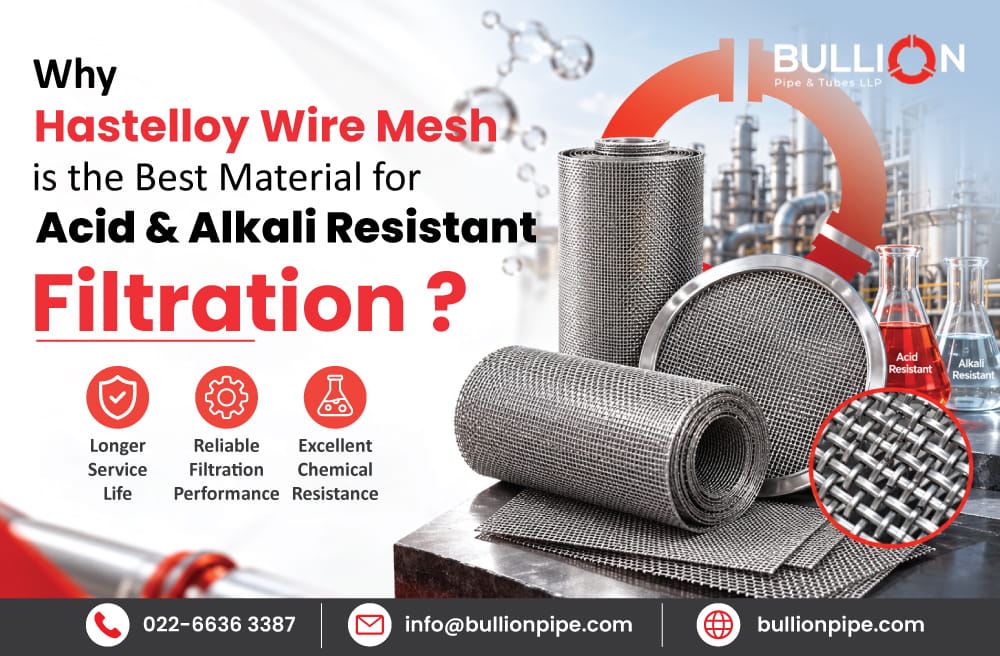
When filtration systems operate in highly corrosive environments, choosing the right mesh material is essential for maintaining filtration efficiency, service life, and process reliability. Conventional stainless steel wire mesh may perform well in many industrial applications, but aggressive acids, alkalis, chlorides, and other corrosive chemicals can demand a more specialized alloy.
This is where Hastelloy wire mesh offers a significant advantage. Known for its exceptional resistance to a wide range of corrosive media, Hastelloy is widely considered for demanding chemical processing, petrochemical, pharmaceutical, pollution-control, and industrial filtration applications.
For applications requiring excellent resistance to localized and general corrosion, Hastelloy C276 wire mesh is one of the most commonly specified options.
What Is Hastelloy Material?
Hastelloy is a family of nickel-based corrosion-resistant alloys designed to withstand severe chemical environments. Depending on the grade, Hastelloy alloys contain varying amounts of nickel, chromium, molybdenum, iron, tungsten, and other alloying elements.
The high nickel content provides a strong corrosion-resistant foundation, while elements such as molybdenum and chromium contribute to resistance against different forms of chemical attack.
Among the various grades, Hastelloy C276 is particularly well known for its resistance to pitting, crevice corrosion, and stress-corrosion cracking in challenging environments. This makes Hastelloy C276 wire mesh suitable for filtration where the mesh may come into direct contact with aggressive chemicals.
Why Is Hastelloy Wire Mesh Suitable for Acid and Alkali Filtration?
The primary reason industries select Hastelloy wire mesh is its ability to maintain material integrity in corrosive environments.
1. Excellent Corrosion Resistance
Acidic and alkaline processing environments can rapidly deteriorate ordinary metals. Hastelloy alloys are specifically engineered for corrosion-resistant performance.
Hastelloy C276 wire mesh can be considered for applications involving various aggressive chemicals, including certain acidic and chloride-containing environments.
However, actual suitability depends on the chemical concentration, temperature, pressure, exposure time, and operating conditions. Material compatibility should therefore be confirmed for each application.
2. Strong Resistance to Localized Corrosion
Filtration equipment can encounter localized chemical attack, particularly in areas where deposits, stagnant liquids, or contaminants accumulate.
Hastelloy C276 offers strong resistance to localized corrosion mechanisms such as pitting and crevice corrosion. This can help maintain the structural integrity of fine filtration media in demanding processing environments.
3. Suitable for High-Temperature Processing
Many chemical and industrial filtration systems operate at elevated temperatures. Temperature can accelerate corrosion reactions and place additional demands on filtration materials.
Nickel-based Hastelloy alloys offer good mechanical and corrosion-resistant properties at elevated temperatures, making them useful for selected high-temperature filtration applications.
4. Excellent Mechanical Strength
Filtration mesh must retain its shape and structural integrity during operation. Hastelloy wire mesh combines corrosion resistance with useful mechanical properties.
This is particularly important when the mesh is subjected to:
- Pressure differences
- Flow-induced forces
- Mechanical handling
- Vibration
- Repeated cleaning
- High-temperature processing
5. Long Service Life in Demanding Environments
Replacing corroded filtration media can result in equipment downtime, maintenance costs, and production interruptions.
Because Hastelloy is designed for severe corrosion environments, using the appropriate grade can potentially increase the service life of filtration components compared with less corrosion-resistant materials.
Who Uses Hastelloy Wire Mesh?
Hastelloy wire mesh is used across industries where filtration takes place in chemically aggressive conditions.
Common applications include:
Chemical Processing: Used for filtration, separation, screening, and processing of corrosive chemicals.
Petrochemical Industry: Suitable for selected filtration and separation systems exposed to aggressive process fluids.
Pharmaceutical Manufacturing: Used in specialized filtration and processing equipment where corrosion resistance and material reliability are important.
Pollution Control: Can be considered for filtration systems exposed to corrosive gases, liquids, and chemical treatment processes.
Power Generation: Certain chemical treatment and process-filtration applications may benefit from Hastelloy’s corrosion resistance.
Food and Process Industries: Specialized applications involving aggressive cleaning chemicals may require highly corrosion-resistant mesh materials.
What Is Hastelloy C276 Wire Mesh?
Hastelloy C276 wire mesh is manufactured by weaving or otherwise forming Hastelloy C276 alloy wire into a mesh structure. Depending on the application, manufacturers can supply different mesh counts, wire diameters, weave patterns, and dimensions.
Common specifications may include:
- Plain weave
- Twill weave
- Dutch weave
- Different mesh counts
- Different wire diameters
- Custom widths and lengths
- Filter discs
- Filter elements
- Screens and sieves
The appropriate mesh specification depends on the required filtration rating, particle size, flow rate, pressure drop, chemical environment, and mechanical requirements.
When Should You Choose Hastelloy Wire Mesh?
Hastelloy wire mesh should be considered when corrosion resistance is a primary material-selection requirement and the operating environment is too aggressive for conventional stainless steel or other standard alloys.
It can be particularly relevant when the filtration system involves:
- Strong acids
- Selected alkalis
- Chloride-containing environments
- Corrosive process chemicals
- Elevated temperatures
- Long operating cycles
- Demanding chemical processing conditions
Importantly, not every Hastelloy grade is suitable for every acid or alkali. Chemical compatibility should always be evaluated against the exact process conditions.
How Do You Select the Right Hastelloy Wire Mesh?
Selecting the correct Hastelloy wire mesh involves more than simply choosing the alloy grade. Consider the following five key parameters:
1. Chemical Environment: Identify the exact acid, alkali, solvent, salt, or process chemical.
2. Temperature: Determine operating and maximum process temperatures.
3. Filtration Requirement: Establish the required mesh size, filtration rating, and particle retention.
4. Pressure and Flow: Evaluate pressure differential, flow velocity, and mechanical loading.
5. Mesh Construction: Select the appropriate weave, wire diameter, dimensions, and component configuration.
For critical applications, provide the manufacturer with the complete process conditions so the appropriate material and mesh specification can be recommended.
Leading Hastelloy Wire Mesh Manufacturer in India
Bullion Pipes is a supplier of industrial metal products and can support buyers looking for corrosion-resistant alloy solutions for demanding applications. When sourcing Hastelloy wire mesh in India, buyers should evaluate the material grade, wire diameter, mesh count, weave, dimensions, manufacturing quality, inspection requirements, and applicable documentation.
A reliable supplier should also be able to provide relevant material documentation and help customers identify a suitable specification based on their filtration requirements.
For industrial buyers, choosing the right Hastelloy wire mesh manufacturer in India is important because material quality and dimensional consistency directly affect filtration performance.
Hastelloy wire mesh is an important option for filtration applications exposed to aggressive chemical environments. Its combination of corrosion resistance, mechanical strength, temperature capability, and resistance to localized corrosion makes it particularly valuable for demanding industrial filtration.
Hastelloy C276 wire mesh is especially relevant where resistance to severe corrosive conditions is required. Nevertheless, material selection should always be based on the actual chemical composition, concentration, temperature, pressure, and filtration conditions.
For companies seeking a Leading Hastelloy Wire Mesh Manufacturer in India, Bullion Pipes can be considered for industrial Hastelloy mesh requirements and customized filtration solutions.
1. What is Hastelloy wire mesh used for?
Hastelloy wire mesh is used for filtration, screening, separation, and process applications where high corrosion resistance is required, particularly in chemical and petrochemical environments.
2. Is Hastelloy C276 wire mesh resistant to acids?
Hastelloy C276 has excellent resistance to many aggressive corrosive environments, including various acidic conditions. Suitability depends on the specific acid, concentration, temperature, and operating conditions.
3. What is Hastelloy material?
Hastelloy is a family of nickel-based corrosion-resistant alloys containing elements such as chromium and molybdenum. Different grades are designed for different corrosive environments.
4. How do I select Hastelloy wire mesh?
Select Hastelloy wire mesh based on chemical exposure, temperature, filtration rating, pressure, flow conditions, wire diameter, mesh count, and weave pattern.
5. Where can I buy Hastelloy C276 wire mesh in India?
Industrial buyers can contact Bullion Pipes for Hastelloy C276 wire mesh requirements and discuss specifications such as mesh count, wire diameter, weave, dimensions, and application conditions.