
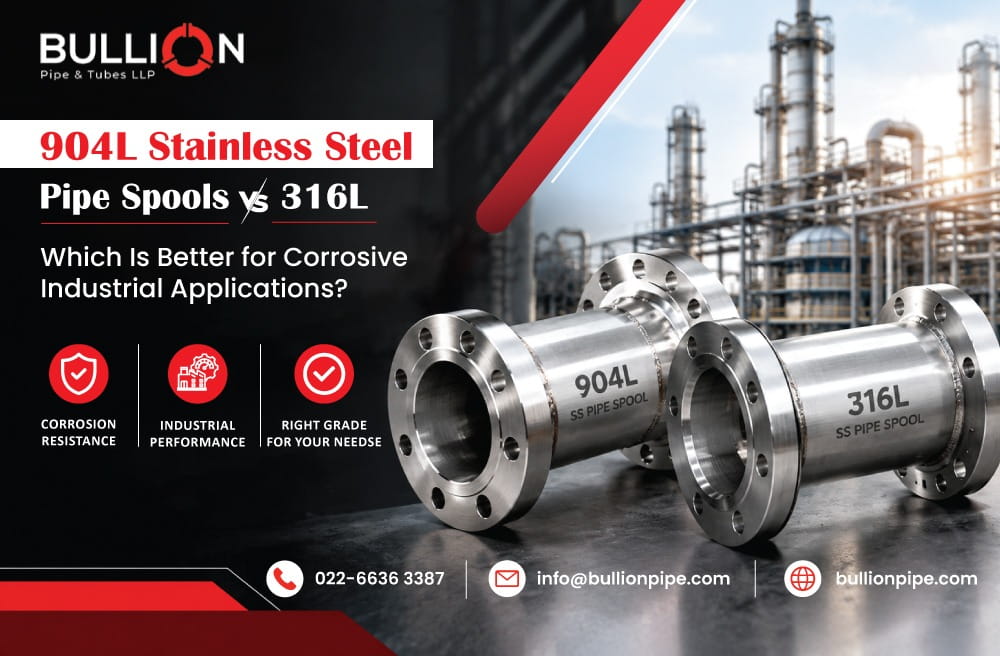
In industrial piping systems, corrosion resistance, reliability, and service life are important properties in many applications. The selection of an appropriate grade of stainless steel can have a profound impact on maintenance, operating costs, and equipment performance. The two classes of stainless steels commonly suggested for applications that are demanding are 904L and 316L.
However, which is better for corrosive industrial applications? This will vary according to the chemical environment, temperature and pressure, fabrication needs, and cost budgets.
904L stainless steel pipe spools may offer a higher degree of corrosion resistance for applications where high levels of aggressiveness are present in the acid and chloride-rich environment. The 316L is practical and widely used for many general chemical, marine, food processing, and industrial applications.
We at Bullion Pipes therefore offer you this blog so you can understand everything you need to know about 904L Stainless Steel Pipe Spools vs 316L, so you can make the best choice for your business needs.
What is a stainless steel pipe spool?
Stainless steel pipe spools refer to pipe segments that are pre-cut, fitted, welded, and assembled with pipe elbows, tees, pipe reducers, flanges, and other fittings. They are normally made in accordance with engineering drawings and project requirements before being delivered to the site.
Prefabrication can help achieve better dimensional accuracy, less welding on site, faster construction, and the ability to better control quality. The grade of stainless steel used for a spool should be compatible with the process fluid and the environment.
What is 904L Stainless Steel?
904L is a high-alloy austenitic stainless steel with a high level of chromium, nickel, molybdenum, and copper. It is formulated for improved resistance to a variety of very corrosive environments.
Copper, nickel, and molybdenum provide 904L with resistance to corrosion in applications using aggressive chemical media. It is especially recommended in cases where there may be excessive corrosion in conventional stainless steel grades.
904L stainless steel pipe spools are therefore selected for applications where corrosion resistance is a primary design criterion, instead of just a desirable property.
What is 316L Stainless Steel?
Molybdenum is added to 316L stainless steel, which gives it better pitting corrosion and crevice corrosion resistance than 304L stainless steel. It is also low-carbon, making it a suitable material for welded use.
316L is generally applied in chemical processing, pharmaceutical, food processing, marine, water treatment systems, and general industrial piping applications.
It is one of the most popular stainless steel grades used in industrial piping in part due to its corrosion resistance, ease of availability, weldability, and relatively low cost.
904L vs 316L: What Is the Difference?
The key difference between them is the amount of alloying that takes place and, consequently, the corrosion resistance. We at Bullion Pipes offer you information in the table below:
| Property | 904L | 316L |
| Corrosion resistance | Very high in many aggressive environments | High for many industrial applications |
| Molybdenum | Higher | Moderate |
| Nickel | Higher | Lower |
| Copper | Present at a significant level | Generally not a major alloying addition |
| Chloride resistance | Better suited to demanding environments | Good, but environment-dependent |
| Acid resistance | Excellent for selected acids and concentrations | Good for many less aggressive conditions |
| Cost | Generally higher | Generally lower |
| Availability | More specialized | Widely available |
| Typical application | Aggressive chemical environments | General chemical, marine and industrial service |
There is a wide variety of types and degrees of availability, along with more specialized types and degrees.
Typical application Aggressive chemical environments General chemical, marine and industrial service
The actual performance of either grade will depend on chemical concentration, temperature, flow conditions, contaminants, welding procedure, and design.
What is the use of 904L Stainless Steel Pipe Spools?
What application is 904L stainless steel pipe spool used for? They may be used for challenging applications like:
Chemical processing plants
Sulfuric acid-related services
Pharmaceutical processing
Pollution-control equipment
Wetlands and marine and offshore environments.Wetlands and marine and offshore environments.
Petrochemical applications
Specialty process piping
Chemical sensitive equipment
There is no replacement for considering the process requirements and applicable engineering standards when selecting materials other than grade selection.
When Does 904L Replacement for 316L Make Sense?
In what scenarios would you choose the 904L type of stainless steel over 316L? It may be considered when corrosion is a concern in the process environment in which 316L is not suitable, or when a greater corrosion resistance margin is desired.
For instance, in environments that are more aggressive and have higher acidity, materials are needed with greater resistance than the traditional stainless steels offer. In some of these applications, 904L’s alloy composition can be beneficial.
However, the selection of 904L with a higher alloy content may not be economical. There may not be much advantage in upgrading to 904L if 316L meets the requirements for corrosion and mechanical properties.
Why is Material Selection Important for Pipe Spools?
What is the importance of material selection in stainless steel pipe spools?
Wall thinning, pitting, leakage, contamination, unplanned shutdown, and replacement are all potential problems that can be caused by corrosion. The choice of material can thus help ensure equipment reliability and lifecycle performance.
The choice should take into account the following:
Process fluid composition
Chloride concentration
The pH of the solution.
Operating temperature
Pressure
Flow velocity
Welded/ fabricated areas
Required service life
Applicable material standards
Total lifecycle cost
By using a technically appropriate material, the likelihood of early failures due to corrosion can be reduced.
Which one to choose between 904L and 316L?
What is the criteria for choosing the appropriate grade for stainless steel pipe spools?
First, identify the environment for operations. Determine the process fluid, concentration, temperature, pressure, contaminants, and anticipated service environment. Next, refer to the material compatibility data as well as project specifications and engineering standards.
316L may be a good combination of performance and cost under relatively moderate corrosive conditions. In more aggressive applications where improved corrosion resistance is desired, 904L can be selected.
Fabrication also matters. Welding procedures, heat input, post-weld requirements, dimensional tolerances, inspection and testing should be determined in accordance with the applicable project specification.
Which Is Better: 904L or 316L?
No single answer can be given for which grade is the “best. Rather, the specific type of use has to be determined.
904L is normally selected for applications that demand the highest level of corrosion resistance in highly corrosive environments. 316L is considered a widely used 316 stainless steel grade when good corrosion resistance, weldability, availability, and cost are significant.
The two grades must be considered in relation to the actual process conditions for a corrosive industrial piping project.
Corrosion conditions, engineering requirements, fabrication considerations, availability, and lifecycle economics are all factors to consider when selecting between 904L stainless steel pipe spools and 316L stainless steel pipe spools.
In specific highly corrosive applications, 904L can be a highly beneficial material, and in other industrial piping applications, 316L is a versatile material. Complete process information and working with an experienced pipe spool supplier can help ensure that the selected grade is suitable for the project’s technical requirements.