
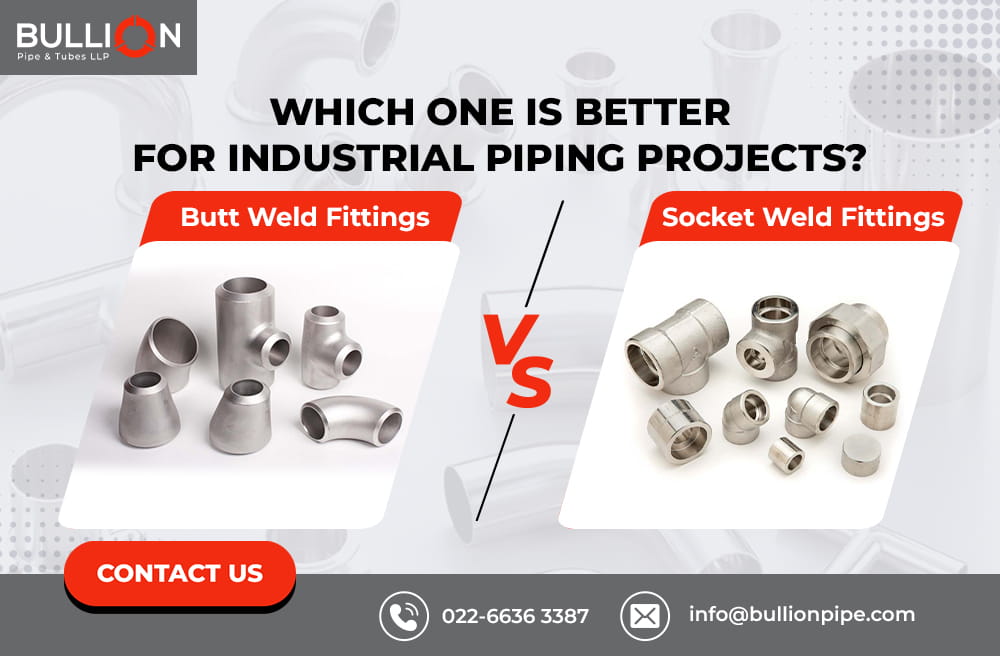
Industrial piping systems constitute the foundation of industries like oil and gas, petrochemicals and pharmaceuticals, power generation, and even food processing. The choice of the best pipe connection technique is essential to maintaining long-term durability and leak prevention as well as operating efficiency. As one of the most frequently used alternatives, the discussion about Butt Weld Fittings and socket welding fittings remains important for engineers as well as project managers.
This in-depth analysis of pipe fittings that includes Butt Weld vs Socket Weld Fittings, which can help businesses understand the advantages, differences, pipe fittings comparison, drawbacks, and the best uses of both types of fitting. For businesses looking for premium Industrial solutions, BullionPipe offers an extensive selection of high-quality pipe fittings designed to meet the demands of industrial settings.
Understanding Butt Weld Fittings
Butt Weld fittings are piping parts that are directly welded to the ends of pipes by the process of butt welding. They are made to ensure a smooth and consistent flow in the pipe system. Common butt weld fittings comprise elbows, tees, caps, reducers, and crosses.
When welding with butts, the edges of the fitting and pipe are angled and joined by heating. This results in a solid and long-lasting connection that can withstand temperatures and pressures.
Key Features of Butt Weld Fittings
- Smooth and seamless internal flow
- Structural strength of high quality
- Ideal for pipes with large diameters
- Great resistance to vibrations and pressure
- Perfect for applications with high temperatures.
Industries typically prefer butt-welded fittings in critical systems, where reliability and leak prevention are crucial.
Understanding Socket Weld Fittings
Socket weld fittings are constructed with a socket that is recessed into which pipes are placed before welding. A fillet weld was then applied to the outer edges of the fitting in order to secure the fitting.
Weld fittings with sockets are typically used for smaller pipe sizes, generally less than 2 inches. These fittings are a favorite for systems where compact design and simple installation are the main requirements.
Key Features of Socket Weld Fittings
- Installation is simple and quick
- Joints with a strong resistance to leaks
- Ideal for small-bore pipe
- Compact design
- Lower installation cost for smaller systems
Weld fittings with sockets are commonly employed in steam, hydraulic, and compressed air systems.
Butt Weld vs Socket Weld: Major Differences
The distinction between these two types of fitting is crucial to selecting the most appropriate solution for industrial piping projects.
1. Welding Method
The main difference in the welding fittings for butt vs socket discussion is in the welding method.
- Butt weld fittings make use of groove welding, where both ends are rounded and joined.
- Socket weld fittings require inserting the pipe into the socket and then applying a fillet weld externally.
Butt welding typically requires more skilled work; however, it gives you more power.
2. Pipe Size Compatibility
Butt weld fittings can be used for both large and small pipe diameters. While Weld sockets are generally intended for smaller pipes.
- Butt weld: Typically employed for 2 inches or over
- Socket welding is usually preferred for pipes with a diameter of less than 2 inches
For large industrial installations, Butt weld fittings are usually the most preferred option.
3. Strength and Durability
In comparing joint strength overall, socket weld fittings typically beat socket fittings.
The continuous welded structure of butt fittings minimizes weak points and enhances resistance to:
- High pressure
- Extreme temperatures
- Thermal expansion
- Mechanical tension
Weld fittings for sockets are strong, but they might not work in the same way under extreme operating conditions.
4. Flow Efficiency
Another aspect important to the pipeline fittings review is the flow performance.
Butt Weld fittings have a smooth bore inside, which reduces turbulent pressure drop and turbulence. They are ideal for applications that require efficient flow of fluid.
Weld fittings with sockets can cause minor flow disruptions because of the socket gap within the fitting.
5. Installation Complexity
Socket Weld fittings are less complicated and quicker to install since it requires less prep work.
Butt weld fittings need:
- Pipe being resealed
- Precise alignment
- The art of welding is a skill that can be learned.
While installation can take longer, fittings with butt welding provide longer-lasting and stronger performance.
6. Maintenance and Inspection
Butt weld joints are simpler to test using radiographic or ultrasonic test methods. They are therefore ideal for industrial applications in which quality control is essential.
Socket weld fittings can be difficult to check internally due to the fact that the weld is outside and the socket’s area is concealed.
Advantages of Butt Weld Fittings:
Superior Strength
Butt Weld fittings have outstanding joint strength, which makes them ideal for high-temperature and high-pressure systems.
Reduced Leakage Risk
The welded connection decreases the chance of leakage as in comparison to threaded or partially welded systems.
Better Flow Characteristics
Smooth interiors enhance the flow rate and lower turbulence.
Long Service Life
These fittings perform extremely well in harsh industrial environments and provide excellent durability.
Suitable for Critical Applications
Industries such as nuclear power plants, refineries, offshore facilities, and nuclear facilities frequently depend on butt weld fittings to ensure safety and dependability.
Advantages of Socket Weld Fittings
Easier Installation
Socket weld fittings are easy to set up and require less work.
Cost-Effective for Small Systems
For pipes with smaller diameters, socket weld fittings can help reduce the cost of labor and materials.
Compact Design
Their smaller dimensions make them ideal for smaller spaces as well as small systems.
Strong Connections for Small Pipes
Despite their small size, socket weld fittings offer solid and durable joints for moderate-pressure use.
Which One Is Better for Industrial Piping Projects?
The answer to Butt Weld vs Socket Weld Fittings will depend on the specific requirements for your application.
Choose Butt Weld Fittings If:
- The system is operated under high pressure.
- High temperatures are the cause.
- The diameter of large pipes is utilized
- A smooth flow is crucial.
- Long-term durability is needed
- The project requires high-end inspection standards.
Choose Socket Weld Fittings If:
- The pipe size is not huge
- The speed of installation is vital.
- Budget constraints exist
- The system operates at moderate pressure
- Space limitations exist
In large-scale industrial pipe systems, weld fittings with butt are usually considered to be the best choice because of their durability, strength, and high performance.
Industries That Commonly Use Butt Weld and Socket Weld Fittings
Butt Weld Applications
- Pipelines for gas and oil
- Petrochemical plants
- Thermal power stations
- Offshore drilling platforms
- Chemical processing units
Socket Weld Applications
- Hydraulic systems
- Steam distribution lines
- Compressed air systems
- Small transfer lines for chemicals
- Instrumentation pipe
Why Choose BullionPipe for Industrial Pipe Fittings?
When choosing industrial piping parts, quality and dependability are crucial. BullionPipe offers premium-quality butt welds and socket weld fittings that are manufactured in accordance with international standards.
The benefits of this include:
- Top-quality raw materials
- Precision manufacturing
- Fittings that resist corrosion
- A wide selection of sizes and grades
- Reliable industrial performance
If your project requires high-end butt weld fittings or compact socket weld options, BullionPipe offers dependable products that can be used in a variety of industrial tasks.
The decision of choosing between butt weld fittings and socket weld is contingent on factors like temperature, pressure, the pipe’s size, the installation requirements, pipe fittings comparison, and the budget for the project. This thorough analysis of pipe fittings clearly clarifies that butt weld fittings provide greater strength, flow efficiency, and long-term endurance, which makes them the ideal choice for industrial applications.
But socket weld fittings are an efficient and cost-effective solution for smaller piping systems, where the ease of installation and a compact design are crucial.
Through understanding the strengths and weaknesses of each type of fitting, industries can make educated decisions that enhance safety, performance, and operational effectiveness.
1. What is the major difference between butt weld fittings and fittings for socket welding?
The major difference is in the welding process. Butt weld fittings are joined end-to-end using beveled edges. Socket weld fittings require placing the pipes into a socket that is recessed before welding it externally.
2. Which is more durable: socket weld or socket?
Butt weld fittings tend to be more durable because they offer a continuous welded connection that has greater resistance to temperature, pressure, or mechanical stresses.
3. What socket fittings are typically employed?
Weld fittings with sockets are typically employed in small-bore piping systems, such as hydraulic systems, steam lines, and compressed air applications.
4. Why do butt-welded fittings get the preference for industrial piping projects?
However, weld fittings made of butt are favored because they provide the smoothest flow, greater endurance, resistance to leaks, and compatibility with high-pressure and high-temperature systems.
5. What is the best choice between socket weld and butt weld fittings?
The selection is contingent on the size of the pipe, its pressure rating, operating conditions, the installation budget, and project needs. Large industrial systems typically require butt-welding fittings.